Opal Galaxy Blog | Australian Opal Guides, Buying Tips & Collector Stories
Ultimate Australian Opal Comparison: Black, Boulder, Crystal, White, Global, and Lab Created Opals
Australian opals are nature’s ultimate light show. Locked inside ancient outback rocks for 100 million years, these gems flash every color of the rainbow with breathtaking brightness. But how do you compare different Australian opal types, and how do they stack up against opals from Ethiopia, Mexico, Brazil, or human made laboratory gems? This comparison guide breaks down host rocks, clarity, water stability, and visual effects side by side so you can easily discover your dream stone.
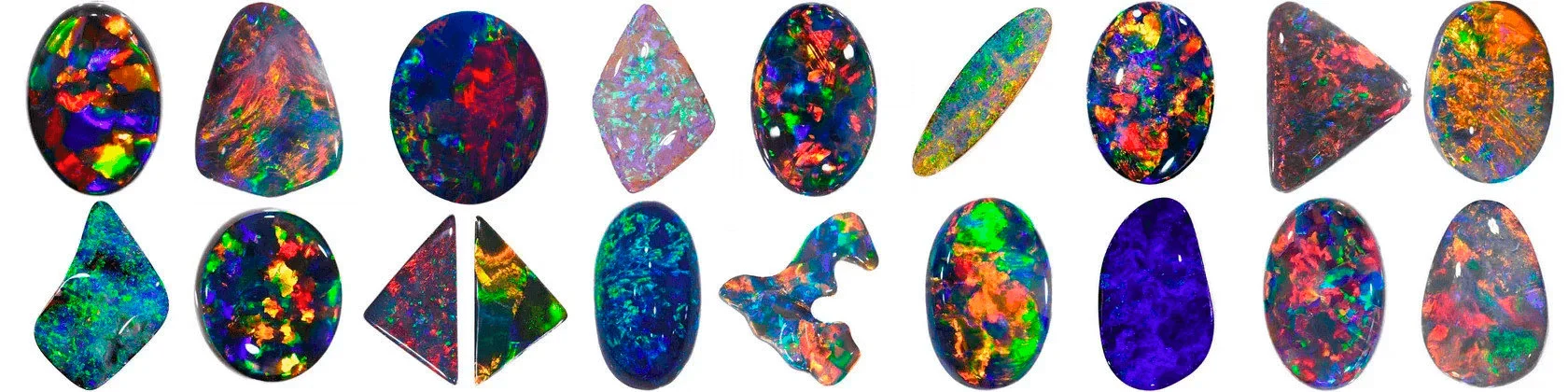
Table of Contents
Introduction to Comparing Australian Opals
Australia is the undisputed capital of precious opals, producing around 95% of the global supply. About 100 million years ago, during the age of the dinosaurs, a giant inland sea called the Eromanga Sea covered central Australia. As the water slowly dried up over millions of years, silica rich fluid filtered down into underground cracks, clay layers, fossil shells, and ironstone rocks.
When the water evaporated, it left behind tiny microscopic spheres of silica stacked like rows of marbles in a box. When light hits these microscopic spheres, it bends and splits into brilliant spectral flashes. This optical phenomenon is called the play of color, and it makes every single opal look like a miniature galaxy in your palm. You can explore deeper geological archives on government geological records or browse national museum gemstone databases.
Because these gems grew in totally different outback environments, their colors and physical builds vary wildly. Comparing their transparency, host rock backing, water resistance, and background shades helps buyers make informed decisions. For general background on gemstone traits, check out our comprehensive opal stone guide.
Direct Pair Comparisons Between Australian Opal Varieties
Black Opals VS Boulder Opals
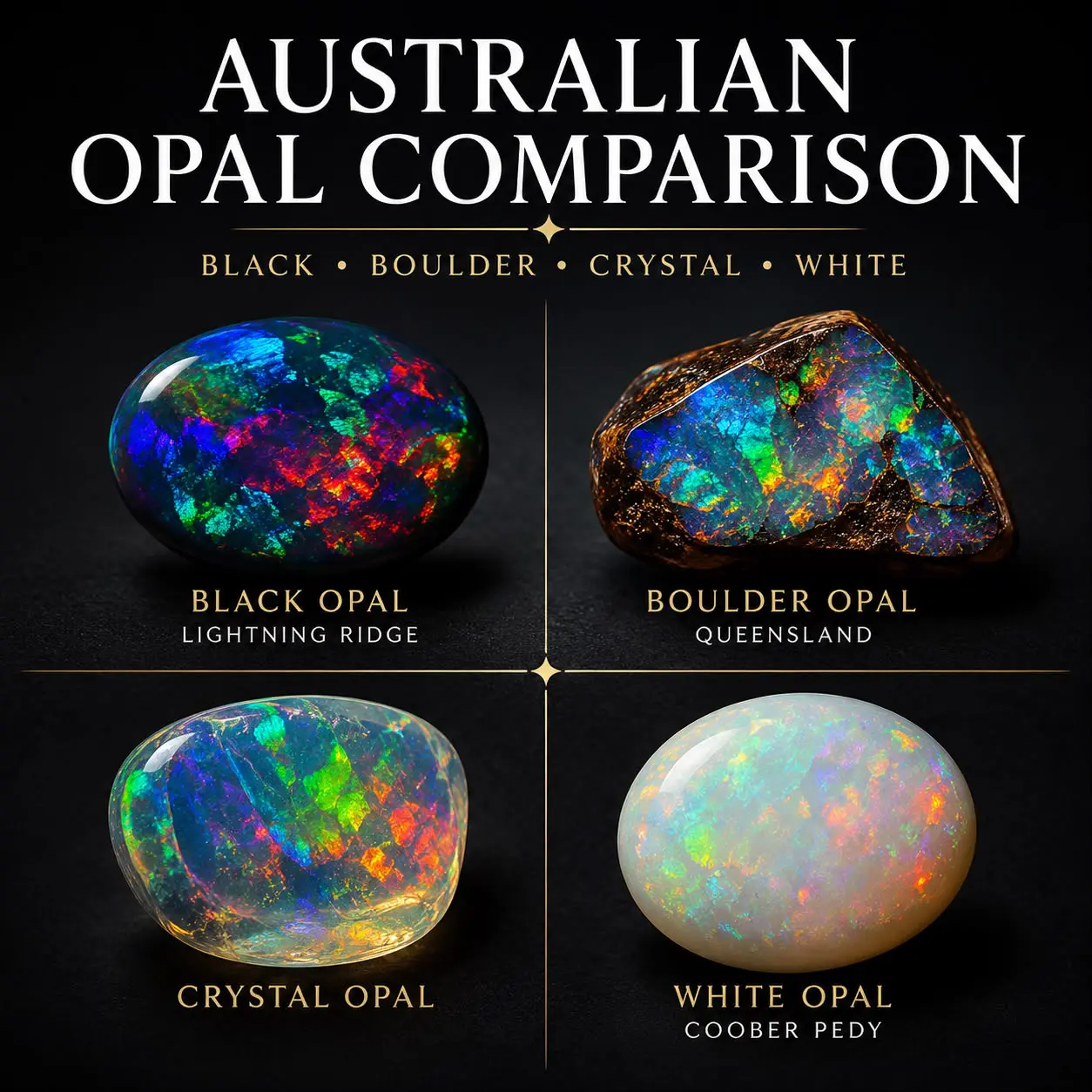
Comparing black opals with boulder opals matches Lightning Ridge elegance against raw Queensland strength.
-
Structure: A black opal consists entirely of solid opal material. The color bar sits on top of natural dark common opal potch without any host rock attached. A boulder opal features a thin color seam naturally fused to rich brown ironstone host rock.
-
Origin & Mining: Black opals are mined almost exclusively deep underground at Lightning Ridge in New South Wales. Boulder opals come from open pit mines scattered across outback Queensland towns like Winton, Quilpie, Yowah, and Koroit.
-
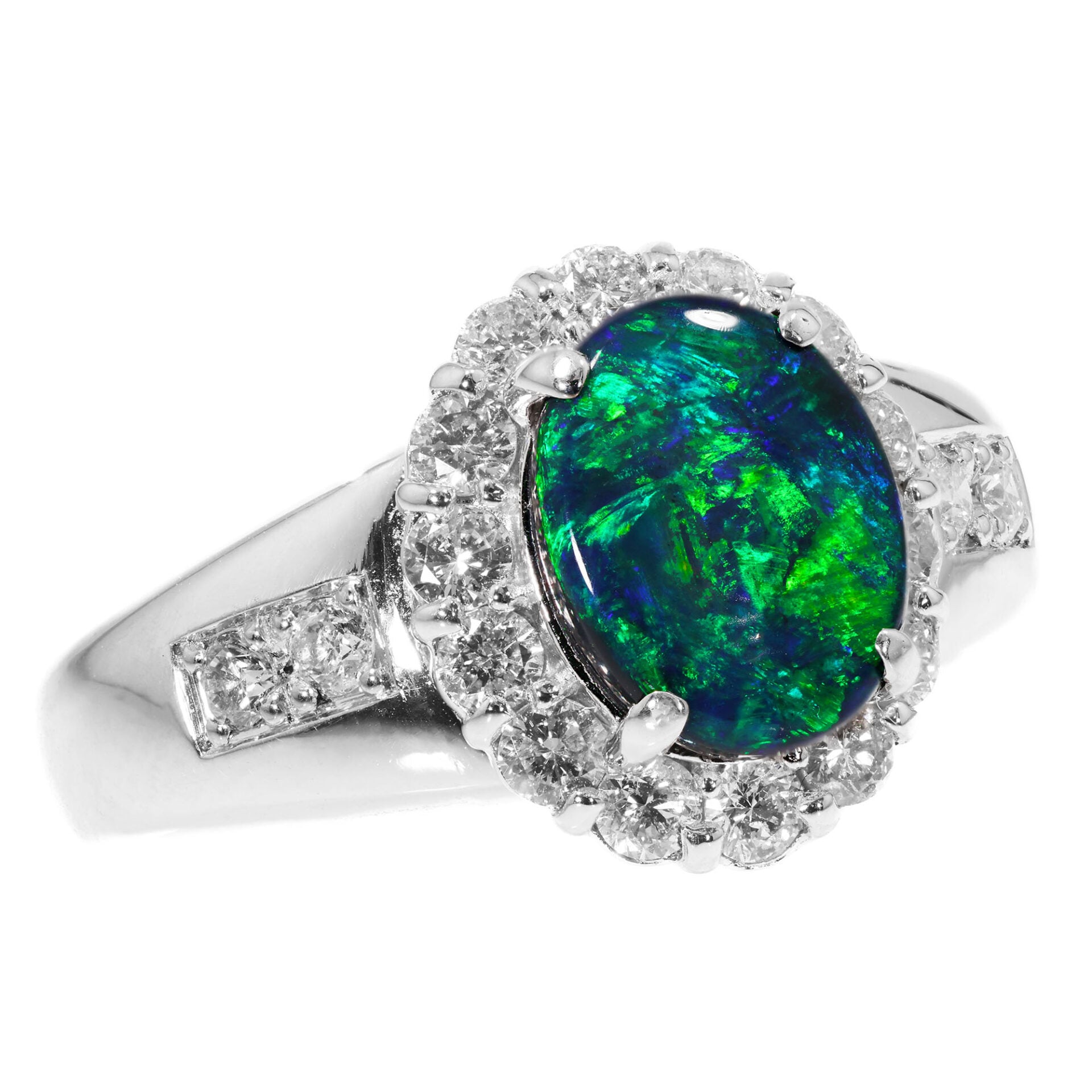
Shape & Cutting: Black opals are shaped into classic, high domed oval cabochons. Boulder opals are carved into organic freeforms that follow the natural undulations of the ironstone rock.
-
Visual Personality: Black opals look like glowing neon lights against a dark midnight sky. Boulder opals feel like wild outback art, combining fiery colors with earthy brown rock textures. Discover more in our guide on boulder opal origins.
Black Opals VS Crystal Opals
Black opals and crystal opals present an exciting visual contrast between rich opacity and watery clarity.
-
Transparency: Black opals are completely opaque with a dark, solid background. Crystal opals feature a clear, glass like body that lets light travel straight through the stone.
-
Light Behavior: Light bounces off the top surface of a black opal, making colors pop with fierce intensity. In a crystal opal, light enters the interior, causing rainbow flashes to float inside the stone like sunlight dancing in water.
-
Jewelry Flexibility: Black opals perform brilliantly in both open and closed back jewelry settings. Crystal opals show floating fairy colors in open settings, but gain deep body contrast when mounted in dark, closed back settings.
Black Opals VS Crystal Boulder Opals
Comparing black opals with crystal boulder opals contrasts solid potch backings with clear opal resting over light sandstone.
-
Backing Composition: Black opals rest on solid dark potch. Crystal boulder opals (often called pipe opals) feature a clear opal layer attached to pale sandstone host rock.
-
Host Rock Removal: The potch backing on a black opal is part of the stone itself. In many cases with crystal boulder opals, cutters can completely trim away the sandstone rock to leave a pure, standalone crystal opal.
-
Visual Depth & Tone: Black opals offer dark background contrast with punchy spectral colors. Crystal boulder opals allow light to shine through clear opal and bounce off light sandstone, creating a bright pastel display with impressive three dimensional depth.
Black Opals VS White Opals
Black opals and white opals sit at total opposite ends of the body tone spectrum.
-
Background Shade: Black opals feature a dark to black base shade. White opals feature a creamy white or pale grey base shade.
-
Color Contrast: The dark base of a black opal works like a dark chalkboard, making electric red, green, and blue fire pop with dramatic contrast. The light base of a white opal displays soft, dreamy pastel rainbow flashes.
-
Rarity & Value: Black opals are the rarest and most valuable gemstones on Earth. White opals are the most abundant Australian type, mined mostly in the subterranean dugout town of Coober Pedy.
Boulder Opals VS Crystal Opals
Comparing boulder opals with crystal opals pits heavy ironstone strength against translucent crystal purity.
-
Host Rock Attachment: Boulder opals always retain their natural ironstone host rock backing. Crystal opals have zero host rock attached.
-
Body Clarity: Boulder opals are opaque because dense brown ironstone blocks all light. Crystal opals have a clear, see through body that allows light to shine straight through from front to back.
-
Durability: The thick ironstone backing gives boulder opals extra physical armor against bumps, making them absolute favorites for daily wear rings and pendants.
Boulder Opals VS Crystal Boulder Opals
Both varieties originate in Queensland outback fields, but their host rock backing and transparency create completely different looks.
-
Host Rock Variety: Standard boulder opals feature opaque precious opal fused to dark brown ironstone. Crystal boulder opals feature clear opal usually attached to pale sandstone.
-
Rock Cutting Flexibility: Ironstone stays permanently fused to standard boulder opals. In contrast, sandstone on crystal boulder opals can frequently be cut away completely to produce a pure crystal opal.
-
Visual Effect: Standard boulder opals showcase fiery colors against deep chocolate brown rock. Crystal boulder opals produce light, vibrant pastel tones as light bounces off pale sandstone.
Boulder Opals VS White Opals
Comparing boulder opals with white opals contrasts rustic host rock strength against smooth, pale porcelain beauty.
-
Rock Backing: Boulder opals feature dark ironstone attached to the back. White opals are solid, pure gemstone cabochons with no rock attached.
-
Visual Contrast: Boulder opals offer intense color contrast against dark brown rock. White opals showcase soft pastel flashes dancing across a smooth white background.
-
Mining Towns: Boulder opals are mined across outback Queensland fields. White opals come primarily from Coober Pedy in South Australia and White Cliffs in New South Wales.
Crystal Boulder Opals VS Crystal Opals
Both options feature see through opal material, but sandstone host rock changes how light performs.
-
Natural Backing: Standard crystal opals have no backing at all. Crystal boulder opals feature clear opal resting on pale sandstone, though cutters can remove the sandstone entirely if desired.
-
Optical Behavior: Light enters a standard crystal opal and passes out through the back. When sandstone remains on a crystal boulder opal, light travels through the clear top layer, hits the light rock backing, and bounces back toward your eye with three dimensional depth.
-
Jewelry Setting: Standard crystal opals change appearance depending on metal settings or clothing underneath. Crystal boulder opals bring their own built in light background.
White Opals VS Crystal Opals
White opals and crystal opals both feature light body shades, but their degree of transparency is completely different.
-
Body Transparency: White opals have an opaque, milky body that blocks light. Crystal opals have a clear body that lets light pass through freely.
-
Color Presentation: White opals display pastel rainbow colors across a smooth white surface. Crystal opals show vivid color flashes glowing from deep within the translucent stone.
-
Lighting Effect: White opals show consistent pastel color in normal indoor lighting. Crystal opals burst into fiery life when spot lighting hits them from different angles.
White Opals VS Crystal Boulder Opals
Comparing white opals with crystal boulder opals matches solid milky gemstones against clear layered gems on sandstone host rock.
-
Gem Structure: White opals are solid pieces of milky opal with no host rock. Crystal boulder opals feature clear opal over pale sandstone, which can also be trimmed off completely to create a pure crystal.
-
Visual Style: White opals offer a traditional, cloud like beauty with soft pastel colors. Crystal boulder opals deliver vibrant three dimensional depth, combining glass like clarity with natural rock textures.
-
Mining Origin: White opals originate mostly in South Australian desert mines. Crystal boulder opals come from Queensland outback pipe formations.
Australian Opals VS Global and Lab Created Gems

Australian Opals VS Ethiopian Opals
Comparing Australian opals with Ethiopian opals highlights vital differences in geology, water absorption, and long term stability.
-
Geological Origin: Australian opals formed slowly over 100 million years inside underground sedimentary rock basins. Ethiopian opals (mined in the Welo province) formed rapidly inside volcanic rock deposits.
-
Water Absorption (Hydrophane Nature): Ethiopian opals are hydrophane, meaning they are porous like a sponge and absorb water, oils, and soap. When soaked, an Ethiopian opal can temporarily lose its color flashes or turn cloudy. Australian opals are non porous, completely water stable, and will never change color or lose their fire when wet.
-
Treatments & Darkening: Natural dark Australian black opals get their dark base naturally from common opal potch. Many Ethiopian opals are artificially smoke treated or soaked in sugar acid solutions to fake a dark body tone.
-
Durability & Value: Solid Australian opals are far more durable, retain their value over decades, and stand as the gold standard for luxury jewelry. Ethiopian opals offer affordable entry level fire but require careful protection from liquids.
Australian Opals VS Mexican Opals
Comparing Australian opals with Mexican opals contrasts rainbow spectral fire against glowing volcanic fire opals.
-
Body Color & Clarity: Mexican fire opals are famous for their fiery orange, yellow, or cherry red body color, often cut into faceted gemstones. Australian opals are celebrated for play of color flashes across black, boulder, crystal, or white background tones.
-
Host Rock Presentation: Mexican Cantera opals form inside pinkish brown volcanic rhyolite rock. Australian boulder opals form inside rich dark brown ironstone or pale sandstone.
-
Visual Style: Mexican opals glow like warm volcanic embers, while Australian opals flash bright multi colored rainbow patterns.
Australian Opals VS Brazilian Opals
Comparing Australian opals with Brazilian opals contrasts massive outback supply against rare South American deposits.
-
Geological Environment: Both Australian and Brazilian opals (mined in regions like Piaui) form in sedimentary rock settings, giving both varieties excellent water stability.
-
Water Content: Brazilian opals typically have a slightly lower water content than Australian opals, making them resistant to heat cracking.
-
Global Availability: Australia supplies roughly 95% of the world’s precious opal, offering incredible variety across black, boulder, crystal, and white types. Brazilian deposits are very small, producing limited quantities mostly consisting of white and crystal opals. You can review additional scientific classifications on mineralogical reference databases.
Australian Opals VS Lab Created Opals
Comparing natural Australian opals with lab created opals matches 100 million years of natural outback creation against factory made imitations.
-
Formation: Australian opals are 100% natural, formed naturally deep within the Earth over millions of years. Lab created synthetic opals (like Gilson opals) are grown in laboratory tanks in a matter of months. Imitations like Opalite are simply man made glass or resin.
-
Pattern & Appearance: Lab created synthetic opals display repeating, geometric lizard skin patterns under magnification. Natural Australian opals feature completely unique, non repeating patterns made by nature.
-
Rarity & Value: Lab created opals can be manufactured endlessly in factories and hold little long term collector value. Natural Australian opals are limited natural treasures that continue to appreciate in value due to shrinking outback supplies.
Comprehensive Opal Comparison Matrix
This side by side matrix directly compares all major Australian, global, and lab created opal varieties.
|
Opal Type |
Geological Origin |
Host Rock Backing |
Water Stability |
Rarity Level |
Key Visual Characteristic |
|---|---|---|---|---|---|
|
Black Opal |
Sedimentary (Lightning Ridge NSW) |
No (Solid Potch Base) |
Fully Water Stable |
Extremely Rare |
Electric rainbow colors popping against a dark base |
|
Boulder Opal |
Sedimentary (Queensland Fields) |
Yes (Brown Ironstone) |
Fully Water Stable |
Rare to Common |
Organic freeforms with bright fire over dark rock |
|
Crystal Opal |
Sedimentary (SA & NSW Fields) |
No |
Fully Water Stable |
Moderately Rare |
See through body with floating internal color flashes |
|
Crystal Boulder Opal |
Sedimentary (Queensland Fields |
Yes (Sandstone, or Cut Off) |
Fully Water Stable |
Rare |
3D pastel fire over sandstone, or pure crystal clarity |
|
White Opal |
Sedimentary (Coober Pedy SA) |
No | Fully Water Stable |
Most Abundant |
Soft pastel rainbow flashes over a milky white base |
|
Ethiopian Opal |
Volcanic (Welo Region) | No | Porous (Hydrophane) |
Abundant |
Bright fire in porous body, often smoke treated dark |
|
Mexican Opal |
Volcanic (Querétaro Fields) | Optional (Rhyolite) | Water Stable | Moderately Rare | Fiery orange and cherry red translucent body |
|
Brazilian Opal |
Sedimentary (Piaui Region) | No | Fully Water Stable | Very Rare | Light crystal body with high heat resistance |
|
Lab Created Opal |
Laboratory Tank | No | Fully Stable | Endless Supply | Geometric lizard skin patterns grown in factories |
How to Choose Between Opal Varieties
Finding the perfect opal comes down to matching your personal lifestyle, design vision, and budget. For step by step buying advice, check our complete opal buying guide.
-
For Everyday Wear Rings & Bracelets: Boulder opals and crystal boulder opals are top choices. Their natural rock backing acts as a protective shield against accidental bumps.
-
For Investment Collections: Natural black opals from Lightning Ridge are globally prized as premier investment gemstones that hold and appreciate in value over time.
-
For Statement Pendant Jewelry: Boulder opals and Mexican Cantera opals offer stunning one of a kind artistic shapes crafted around natural host rocks.
-
For Budget Friendly Natural Rainbow Fire: White opals deliver classic pastel colors at accessible prices, while crystal opals provide incredible versatility for custom bezel settings.
To dive into more guides, browse our educational opal articles.
Conclusion
Every opal variety on Earth tells its own unique geological story. Black opals captivate with dark electric contrast, boulder opals unite raw ironstone strength with brilliant fire, crystal opals dazzle with transparent depth, crystal boulder opals combine clear color with pastel sandstone backings, and white opals offer soft classic beauty. Meanwhile, comparing Australian opals against Ethiopian, Mexican, Brazilian, and lab created stones proves why solid Australian outback gems remain the world’s most stable, valuable, and cherished treasures.