Opal Galaxy Blog | Australian Opal Guides, Buying Tips & Collector Stories
Aboriginal Opal Story: Dreamtime Tales and Rainbow Serpent Legends
Aboriginal opal stories pass down through Dreamtime legend across multiple First Nations whose lands cover the Australian opal fields, with each nation holding its own version of how opal came to be. The most widely shared story tells of the Creator descending to earth on a rainbow to deliver a message of peace, with the stones coming alive where the rainbow touched the ground and sparkling with every color of the spectrum to become the first opals. Other versions tell of a giant opal carrying the fire of the world, opals formed from the tears of ancestors, and stones born from lightning striking the earth, with each story tied to the country and language of the people who shared it. Below is a full guide to the Aboriginal opal stories, covering the major Dreamtime versions, the nations they belong to, and the cultural importance of opal to Australia’s First Nations people.
Understanding Aboriginal Culture and Connection to Opals
Indigenous Australians, also known as Aboriginal people, have inhabited Australia for over 65,000 years, making them the world’s oldest continuous living culture. Their deep spiritual connection to the land includes powerful stories about how opals came to exist. These opal story traditions form part of the Dreamtime, the Aboriginal understanding of how ancestral beings created the world and everything in it.
Central to many Aboriginal opal stories is the Rainbow Serpent, a powerful creator being believed to have carved Australia’s rivers and waterways. According to Aboriginal belief, the sacred waters blessed by this serpent, sourced from the ancient Great Artesian Basin, played a crucial role in opal formation. These opal dream stories connect the gemstones to creation itself, making them far more than beautiful stones. They represent living links to the oldest culture on Earth.
Aboriginal communities near major opal fields including Andamooka, Wallangulla (Lightning Ridge), Central Queensland, Coober Pedy, and Mintabie have preserved these stories through countless generations. Each region where opals are discovered holds its own unique opal story explaining how these rainbow colored stones came to rest in the earth.

The Rainbow Serpent Opal Connection
The rainbow serpent opal connection runs deep through Aboriginal mythology. This powerful ancestral being moved across the landscape during the Dreamtime, creating the natural features we see today. According to Aboriginal Dreamtime beliefs, the Rainbow Serpent controlled water, the most precious resource in Australia’s often dry climate.
The serpent’s movements formed rivers, waterholes, and underground water systems. Where the Rainbow Serpent traveled, it left its mark on the land and within the earth itself. The colors trapped in opals represent the Rainbow Serpent’s essence, captured forever in stone. This explains why opals shimmer with all the colors of the rainbow, the same colors that appear when the serpent moves between waterholes during rainstorms.
Aboriginal people traditionally approached waterholes with great respect, singing out to the Rainbow Serpent from a distance to announce their presence and good intentions. They recognized the serpent’s power over water, knowing it could bring life giving rains or cause devastating droughts and floods if offended. This same reverence extended to opal bearing sites, which were considered sacred places where the Rainbow Serpent’s power remained present in physical form.

Andamooka: The Rainbow’s Touch
In Andamooka, South Australia, the opal story tells of ancestral beings descending to Earth along a rainbow bridge during the Dreamtime. Where this magnificent rainbow touched the red desert earth, ordinary rocks and pebbles underwent a magical transformation, giving birth to the first opals.
Tribal groups gathered at these sacred sites as the Dreamtime creator beings shared the laws governing the land and its people. The opal outcrops held profound significance and were reserved strictly for ceremonial purposes. The people believed these locations marked where the rainbow would one day return, creating a bridge between the earthly and spiritual realms once again.
The opals themselves served as physical proof of this celestial visitation. Each stone contained fragments of that original rainbow, trapped in the earth as a reminder of the connection between sky and land. This Coober Pedy and Andamooka region continues to produce stunning opals that Aboriginal people see as gifts from the Dreamtime.

Wallangulla (Lightning Ridge): Gurria’s Rainbow Scales
For the Yuwaalaraay people from the Wallangulla area, known today as Lightning Ridge, their opal story involves a cunning crocodile named Gurria and the supreme spirit Bhiamie. This tale from the opal tribe explains the origin of the region’s famous black opals.
The supreme spirit Bhiamie traveled through the outback with his two wives: Birring Ooloo, the mother of nature, and Cunnum Biellie, the law maker and teacher. While the three were swimming in a sacred spring, the crocodile Gurria secretly followed them, coveting their powerful spirits for himself.
In a moment of treachery, Gurria swallowed both women and swam down the Narran River, believing he had claimed their power. However, Bhiamie tracked the crocodile to a distant lake and speared him at Weetalibah water crossing. As Gurria lay dying in agony, his thrashing body created two deep holes: one formed by his tail (now Coocoran Lake) and another by his snout (Angledool Lake).
As Gurria took his final breaths, rain began to fall and a magnificent rainbow appeared across the sky. The brilliant colors of the rainbow became trapped within the dying crocodile’s scales. As his body sank into the earth, those rainbow colors were sealed into the ground, forming the first black opals. Bhiamie freed his wives from within Gurria’s body and, with the help of Ghee jar, a small black ant, brought them back to life.
The Yuwaalaraay people believe that when you hold a Lightning Ridge opal, you see the very colors that were captured from that ancient rainbow, forever preserved in the transformed crocodile’s scales. This opal story explains why Lightning Ridge produces the world’s finest black opals with such intense color.

Central Queensland: The Weeping Opal
In Central Queensland, a powerful opal story tells of the weeping opal, originating when a colossal opal spirit watched over the land during the dawn of creation. Two mighty tribes engaged in fierce warfare across the plains, fighting until all their weapons were exhausted, then hurling boulders at one another in their rage.
One particularly strong warrior threw a massive boulder with such force that it flew high into the sky and became stuck among the clouds. The boulder began to swell and expand until it finally burst open, revealing the radiant colors of an enormous opal suspended in the heavens.
As the opal spirit gazed down upon the devastation below, witnessing the destruction the warring tribes had wrought upon the land and each other, it began to weep. The spirit’s tears fell as a great rainstorm, washing across the battleground. When the sun finally broke through the clouds, its light passed through the falling tears, and the surviving warriors witnessed their first rainbow stretching across the sky.
The tears that fell to earth formed the boulder opals found throughout the region, each containing the sorrow and hope of that pivotal moment. In opal stories passed down through countless generations, Aboriginal people teach that the appearance of a rainbow signifies awareness of wrongdoing against tribal laws and the natural order. The rainbow serves as a reminder that the gem’s tears continue to fall in sorrow when people harm the land or each other, but also offer hope for reconciliation and healing.

Coober Pedy: The Fire in the Stone
The Arabana and Antakirinja Matu Yankunytjatjara peoples of the Coober Pedy region hold opal dream stories of how fire spirits traveled beneath the earth during the Dreamtime. These ancient beings moved through underground spaces, their essence igniting and transforming the rocks they touched.
When these fire spirits encountered water seeping through the ancient sea floor, their meeting created an explosion of color that became trapped in the stone, forming the luminous opals. The name Coober Pedy itself comes from the local Aboriginal term “kupa piti,” meaning “white man’s hole,” referring to the dugout homes and mines created later by European settlers.
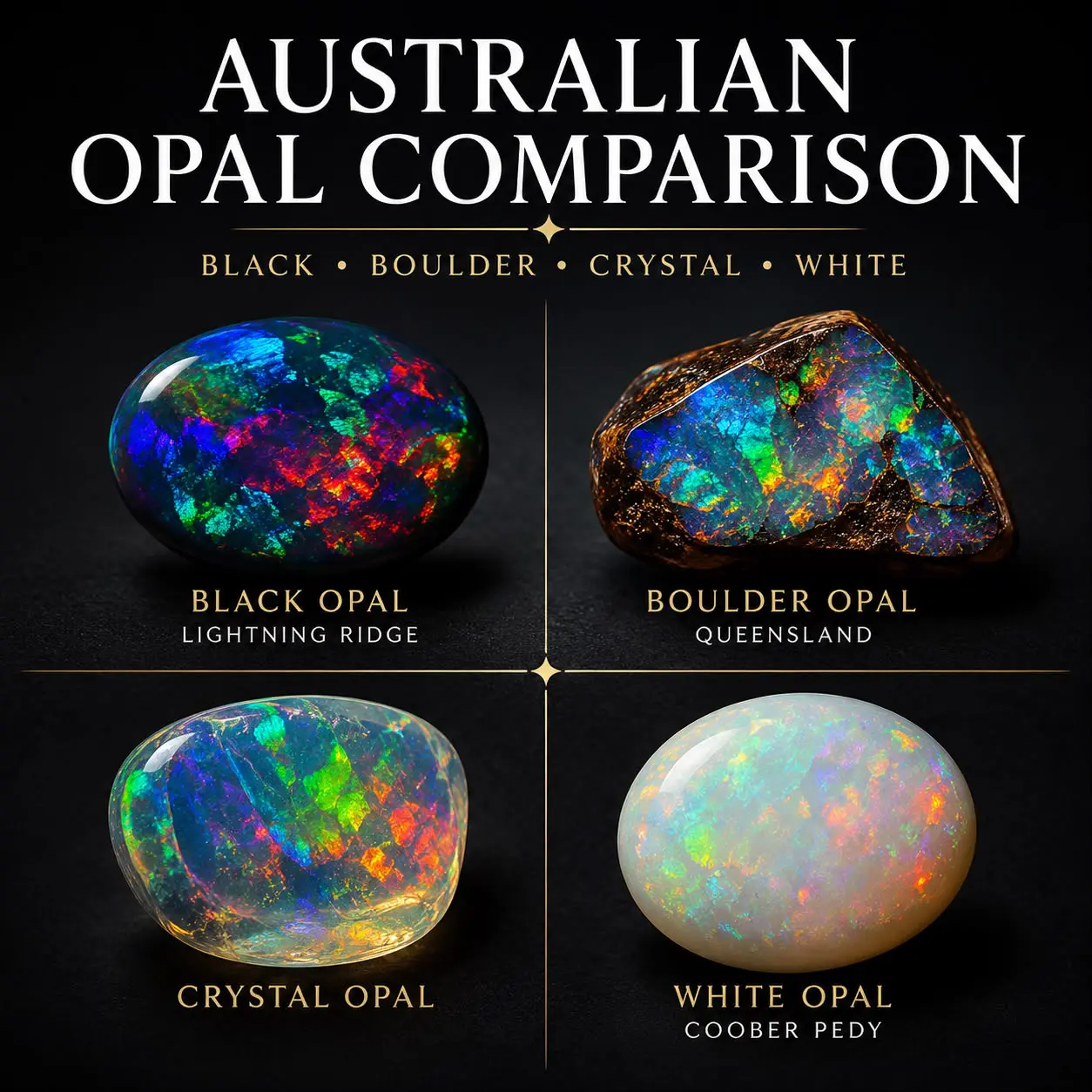
Before European arrival, the area was known as a place where the earth held captured fire and light. Aboriginal people recognized these special stones but considered them spiritually powerful, treating them with great respect and using them only for specific ceremonial purposes. The crystal and white opals from Coober Pedy still carry this sacred significance in Aboriginal culture.

Mintabie: Stars Fallen to Earth
In the Mintabie region, Aboriginal opal story traditions tell of a time when the night sky was so close to the earth that people could almost touch the stars. One night, a great wind swept across the sky, shaking loose dozens of stars that fell to the ground. Where these stars struck the earth, they shattered into countless fragments, their celestial light becoming imprisoned in the rocks below.
The elders taught that opals from this region contain actual starlight, which explains why they seem to glow with an inner fire that shifts and changes like the night sky itself. These fallen star fragments were considered gifts from the sky ancestors, carrying messages and power from the celestial realm to the earthly one.
When Aboriginal people found these stones, they understood them as connections to their ancestors who had become stars. The opal dream made manifest, linking earth and sky through these shimmering gemstones.

White Cliffs: The Moon’s Reflection
The Aboriginal peoples near White Cliffs in New South Wales tell an opal story of how the moon spirit, traveling across the night sky, became lonely and wished to leave a part of herself on the earth below. She cast her reflection into the ancient inland sea that once covered the area.
As the waters slowly receded over countless ages, the moon’s reflection became trapped in the seams and layers of rock. The people believed that opals from White Cliffs carry the moon’s gentle energy, which explains why they often display soft, milky colors and a mysterious glow.
These stones were especially valued by women in ceremonial practices, as they connected the feminine energy of the moon to the earth and its people. The opal tribe women used these stones in rituals marking important life transitions, believing the moon’s power remained alive within them.

Winton and Opalton: The Dinosaur Dreams
Aboriginal peoples in the Winton and Opalton regions of Queensland recognize a special connection between the ancient creatures whose bones became fossils and the boulder opals found in the same ground. Their opal story explains that during the Dreamtime, great spirit creatures walked the earth, much larger and more powerful than today’s animals.
When these spirit creatures completed their earthly journeys, they returned to the ground, their essence transforming over countless generations. The rainbow colors that sometimes appear in the ironstone where their remains rest represent the spirits of these ancient beings, still present and still powerful.
Some Winton boulder opals contain fossilized wood or vegetation, which Aboriginal people see as proof that the Dreamtime beings transformed all living things into colored stone when their time on earth ended. Finding an opal with fossilized material means discovering a direct link to those ancient spirit creatures.

The Cultural Significance of Opals in Aboriginal Lore
Beyond their mythological origins, opals hold deep ceremonial and spiritual meaning for many Aboriginal groups across Australia. These precious stones served far more than decorative purposes. They functioned as sacred links to the Dreamtime, acting as markers of sacred sites, totems, and physical manifestations of ancestral presences.
Certain opals were believed to store ancestral memory and wisdom, connecting land, spirit, and story in shimmering, tangible form. According to traditional Aboriginal cosmology, each sparkle within an opal echoed the movement of ancestral spirits across the land during creation. The play of color represented the ongoing dance between the physical and spiritual worlds.
Elders passed down these opal story traditions to younger generations through songlines, which are narrative maps that traverse Country and time. These songlines connect sacred sites and stories across vast distances, with certain opals marking important locations along these ancient paths. Walking a songline meant following the footsteps of ancestral beings, and the opals found along these routes confirmed you were on the correct path.
Ceremonial Use and Spiritual Power
The opal tribe communities used these stones in various ceremonies marking important life transitions. Young people undergoing initiation rites might receive an opal as a connection to their totem animal or clan. The specific colors in the opal could indicate which ancestral spirits watched over that person.
Healing ceremonies sometimes incorporated opals, as their connection to water (through the Rainbow Serpent) and their inner fire (from Dreamtime creation) gave them power over both cooling and warming illnesses. Medicine people who knew the correct songs and rituals could activate an opal’s healing properties.
Women’s ceremonies particularly valued certain opals for their connection to fertility, menstruation cycles, and the creative power of birth. The changing colors in an opal mirrored the changes women’s bodies go through, making them powerful symbols of feminine strength and creativity.
Land Stewardship and Sacred Responsibility
The reverence for opals in Aboriginal culture serves as a profound reminder of the importance of land stewardship. Aboriginal communities view the land not as property to be owned, but as a living, interconnected presence that sustains and is sustained by its people.
In this worldview, opals are not simply gemstones to be extracted and sold for profit. They are witnesses to ancient journeys, physical manifestations of creation stories, and spiritual artifacts that echo with more than 65,000 years of continuous cultural heritage. Taking an opal from the ground without proper respect and ceremony could anger the ancestral beings who created them.
Traditional Aboriginal practice involved singing to the land before taking anything from it, explaining why you needed the stone and how it would be used. This same respect extended to the Rainbow Serpent opal sites, where people would announce their presence from a distance and ask permission before approaching.
Opals and Aboriginal Identity Today
For Aboriginal Australians today, the opal story traditions remain vitally important. These stories connect present generations to their ancestors, to Country, and to the spiritual forces that continue to shape the world. When Aboriginal people see opals displayed in museums or jewelry stores, they see more than pretty rocks. They see pieces of their history, fragments of creation, and tangible links to the Dreamtime.
Many Aboriginal communities have worked to reclaim agency over opal sites on their traditional lands. They seek to balance the economic benefits of opal mining with the need to protect sacred sites and maintain spiritual connections. Some communities have developed their own mining operations, ensuring that opals are extracted respectfully and that Aboriginal people benefit directly from their ancestral lands.
The opal dream continues in contemporary Aboriginal art, where artists depict the Rainbow Serpent, creation stories, and the spiritual significance of opals in paintings, carvings, and other media. These artworks keep the ancient stories alive while adapting them for new generations and sharing them with the wider world.
Respecting Aboriginal Opal Stories at Opal Galaxy
At Opal Galaxy, we recognize the deep cultural significance that opals hold for Aboriginal Australians. Every Australian opal we offer comes from land that has been home to Indigenous peoples for over 65,000 years. The stones we source carry not just geological history, but cultural memory and spiritual significance.
We work to source our opals ethically, respecting the land and acknowledging the traditional custodians of the regions where these gemstones are found. Whether from Lightning Ridge, Coober Pedy, Winton, or other mining areas, each opal connects to thousands of years of Aboriginal presence and story.
When you purchase an opal from Opal Galaxy, you acquire more than a beautiful gemstone. You become a guardian of a stone that Aboriginal people consider connected to the Dreamtime, to the Rainbow Serpent, and to the ancestral beings who shaped Australia. We encourage all opal owners to learn about and respect the Aboriginal opal story traditions associated with these remarkable gems.
The Living Opal Story
The opal story traditions of Aboriginal Australia remind us that these gemstones represent far more than monetary value or aesthetic beauty. They embody the oldest living culture on Earth, preserve creation memories from the Dreamtime, and maintain connections between people, land, and spirit that have endured for over 65,000 years.
When Aboriginal people speak of the rainbow serpent opal connection, they speak of Country itself, of the ancestors who shaped it, and of the responsibilities that come with walking upon and caring for these ancient lands. The stories teach that every opal carries within it not just millions of years of geological formation, but cultural memory, spiritual significance, and the enduring connection between people and place.
These opal dream stories continue to guide Aboriginal communities today, teaching respect for the land, cooperation between people, and recognition of the sacred in the natural world. The Rainbow Serpent still moves through the waterholes, the weeping opal still falls as rain, and the stars that became opals still shine with their ancient light.
At Opal Galaxy, we honor these traditions by treating every opal with the respect it deserves as both a natural wonder and a cultural treasure. Explore our collection of authentic Australian opals and become part of a story that began in the Dreamtime and continues today.