Opal Galaxy Blog | Australian Opal Guides, Buying Tips & Collector Stories
Opal Price: How Much Do Australian Opals Cost
Opal price ranges from around $10 per carat for common white opal to over $10,000 per carat for top gem grade Australian black opal. The final value depends on opal type, body tone, play of color, pattern, size, and origin, with black opal from Lightning Ridge sitting at the top of the market. Boulder opal from Queensland and crystal opal also command strong prices, while doublets, triplets, and synthetic stones sell for far less. Below is a full breakdown of how opals are priced, what drives value, and what to expect across each category.
Australian opal prices range from under $10 per carat for commercial grade white opal to over $50,000 per carat for exceptional black opal with rare patterns and dominant red fire. Australia produces over 90% of the world’s precious opal supply, and Australian material commands the highest prices globally. Unlike diamonds, which follow a standardised pricing system, every opal is unique and no universal grading scale exists. According to the GIA, the primary quality factors for opal are color, pattern, clarity, and cut, but the market also weighs brightness, body color, origin, carat weight, and shape. This guide breaks down opal prices by type with real per carat ranges, then explains every factor that moves the price up or down.
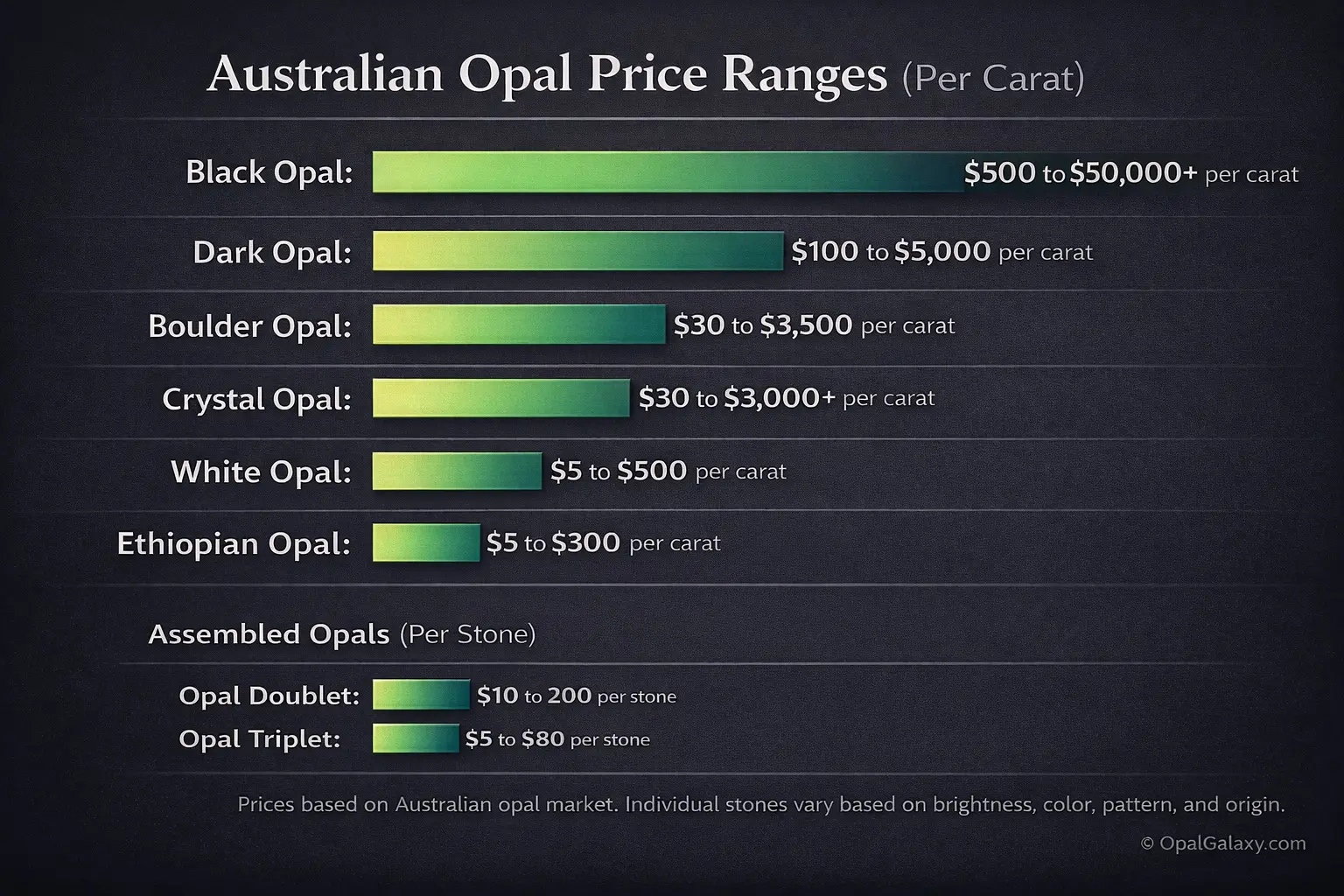

Opal Price by Type
The type of opal is the starting point for pricing. Each type occupies a different price tier based on rarity, visual impact, and market demand.
Black Opal Price

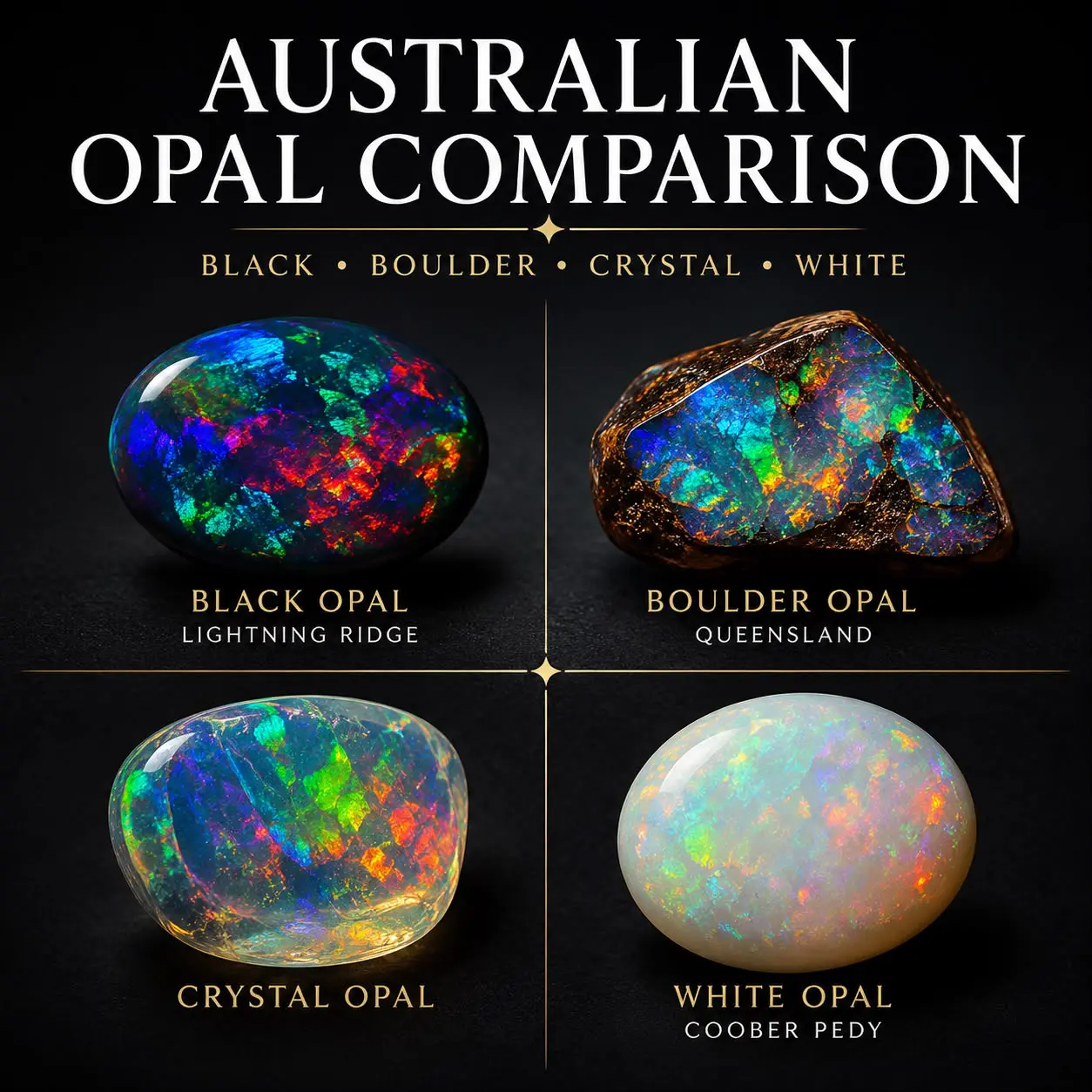
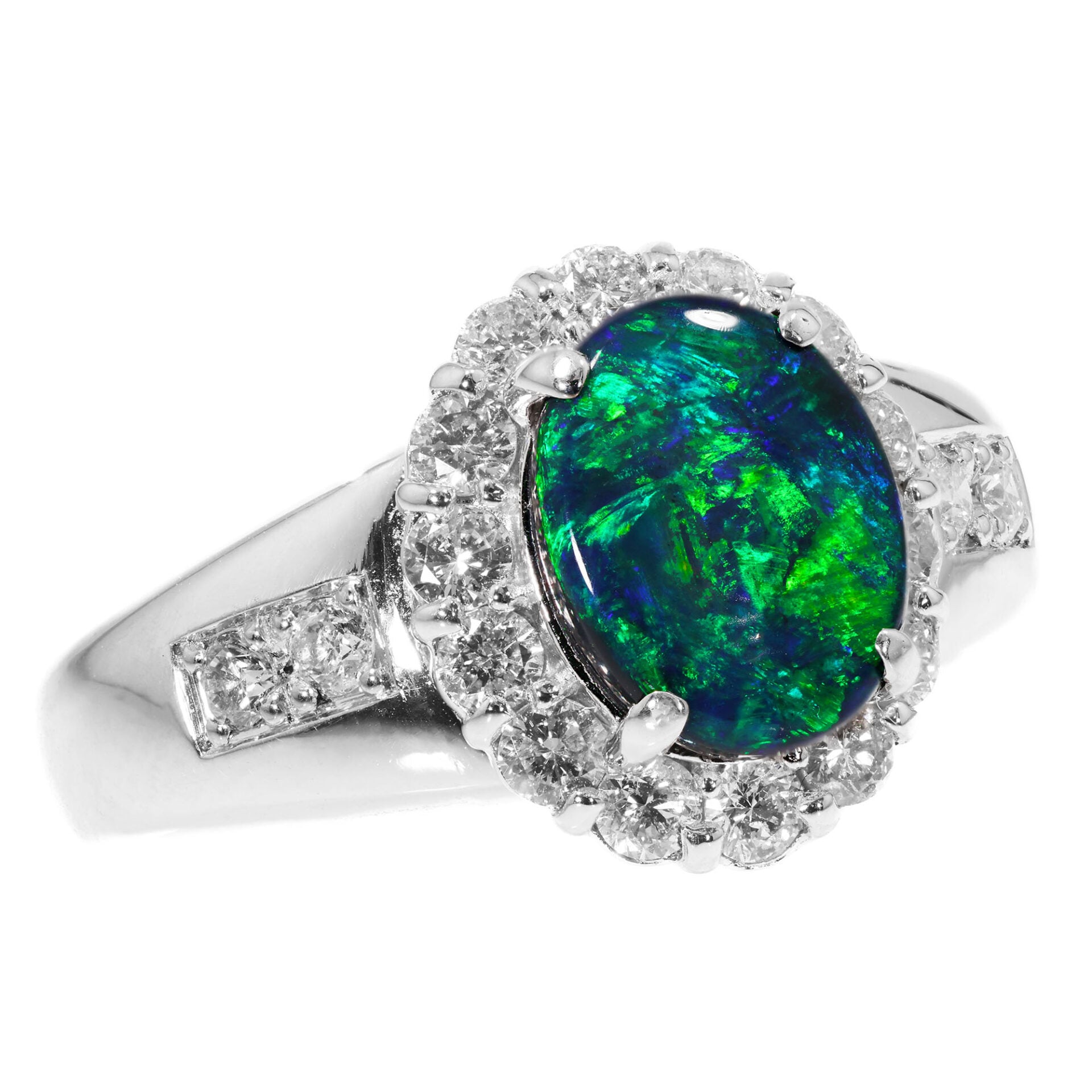
Origin: Lightning Ridge, New South Wales Price Range: $500 to $50,000+ per carat Black opal is the most valuable and most expensive opal type. Its dark body color creates strong contrast that makes fire appear far more vivid than in lighter opals. At the top end, black opals with rare patterns like harlequin and dominant red fire have sold for over $10,000 per carat at auction. Commercial grade black opals with moderate brightness and common patterns typically range from $500 to $3,000 per carat. Black opal represents less than 5% of total Australian opal production, which drives its premium pricing. Lightning Ridge is the only place in the world where black opal is mined at commercial scale.
Dark Opal Price
Origin: Lightning Ridge (NSW), Mintabie (SA) Price Range: $100 to $5,000 per carat Dark opal has a grey body color that sits between black opal and white opal. It offers similar visual characteristics to black opal but at a lower opal price because the body color is not as dark. Mintabie in South Australia historically produced high quality dark opals, but mining in the region has largely ceased, making authentic Mintabie pieces increasingly collectible.
Boulder Opal Price

Origin: Queensland (Winton, Quilpie, Yowah, Koroit) Price Range: $30 to $3,500 per carat Boulder opal is the second most valuable opal type after black opal. The natural ironstone backing creates a dark background similar to black opal, enhancing color contrast. Full face boulder opals from Winton with vivid color and no visible ironstone on the face command the highest prices. Koroit boulder opals with spectacular matrix patterns are prized by collectors. Be cautious when calculating boulder opal price by weight alone, as the ironstone backing can make the stone significantly heavier without adding opal value.
Crystal Opal Price
Origin: Lightning Ridge (NSW), Coober Pedy (SA) Price Range: $30 to $3,000+ per carat Crystal opal is transparent or semi transparent, allowing light to pass through the stone. Black crystal opals (transparent with a dark body) from Lightning Ridge are the most valuable in this category and can match or exceed the price of some solid black opals. Light crystal opals from Coober Pedy typically fall in the $30 to $500 per carat range. Crystal opal prices from Lightning Ridge generally carry a premium over those from other regions.
White Opal Price

Origin: Coober Pedy (SA), White Cliffs (NSW) Price Range: $5 to $500 per carat White opal has a white or pale body color. It is the most common opal type and the most affordable of the solid natural opals. However, exceptional white opals with brilliant fire and strong pattern can exceed $1,000 per carat. Coober Pedy is the world’s largest single source of white opal by volume. White opal prices are the most accessible entry point for new opal buyers.
Opal Doublet Price
Price Range: $10 to $200 per stone An opal doublet is a two layer assembled stone, not a solid natural opal. It consists of a thin slice of natural opal cemented onto a dark backing. Doublets typically sell for around 15 to 35% of the price of a comparable solid opal. They should never be priced or sold as solid opals.
Opal Triplet Price
Price Range: $5 to $80 per stone An opal triplet is a three layer assembled stone with a dark backing, a thin slice of opal, and a clear dome cap. Triplets are the most affordable way to own an opal and are commonly used in fashion jewelry. Opal triplet prices are minimal compared to solid opals.
Ethiopian Opal Price
Origin: Welo Province, Ethiopia Price Range: $5 to $300 per carat Ethiopian opal is the primary non Australian alternative on the global market. Ethiopian opals are hydrophane, meaning they absorb water and can temporarily lose their fire when wet. This property makes them less stable than Australian opals for jewelry use. Ethiopian opal prices are typically 80 to 90% less per carat than comparable Australian stones. For more on the differences, see our article on treated Ethiopian opals.
What Makes Opal Prices Go Up
Each of the following factors is evaluated independently, but they work together to determine the final opal price. An opal that scores high across all factors will be worth exponentially more than one that is strong in only one area.
Brightness
Brightness is the single most important factor in opal pricing. It measures how vivid and intense the fire appears to the naked eye. A brilliant opal shows fire in any lighting condition, even dim indoor light. A dull opal only shows faint color under direct light. The difference in opal price between a brilliant and a dull stone of the same type, size, and origin can be 10 times or more. A brilliant white opal can be worth more per carat than a dull black opal. Brightness is typically assessed under a neutral white LED light source. For more detail, read our guide on what makes an opal valuable.
Body Color
The body color is the background color of the stone, ignoring the fire. A darker body color creates stronger contrast and makes the fire pop. This is why black opal prices are the highest in the opal market. A black opal and a white opal could have identical fire, but the black opal will appear far more striking because of the dark canvas behind the color. Darker body color within the same opal type always increases the opal price.
Color of Fire

The colors visible in an opal’s fire directly affect its price. Red is the rarest and most valuable fire color. It requires the largest silica sphere arrangement (approximately 300 to 350 nanometres) to form, which occurs less frequently in nature. Blue is the most common fire color, requiring the smallest silica spheres (approximately 150 to 200 nanometres).
The color hierarchy from most to least valuable: red, then orange, then yellow and gold, then green, then blue. An opal showing a full spectrum of colors, especially if it includes dominant red, is worth significantly more than a single color stone. A single color blue opal might sell for $200 per carat, while a comparable multicolor opal with red could sell for $2,000 or more per carat.
Pattern
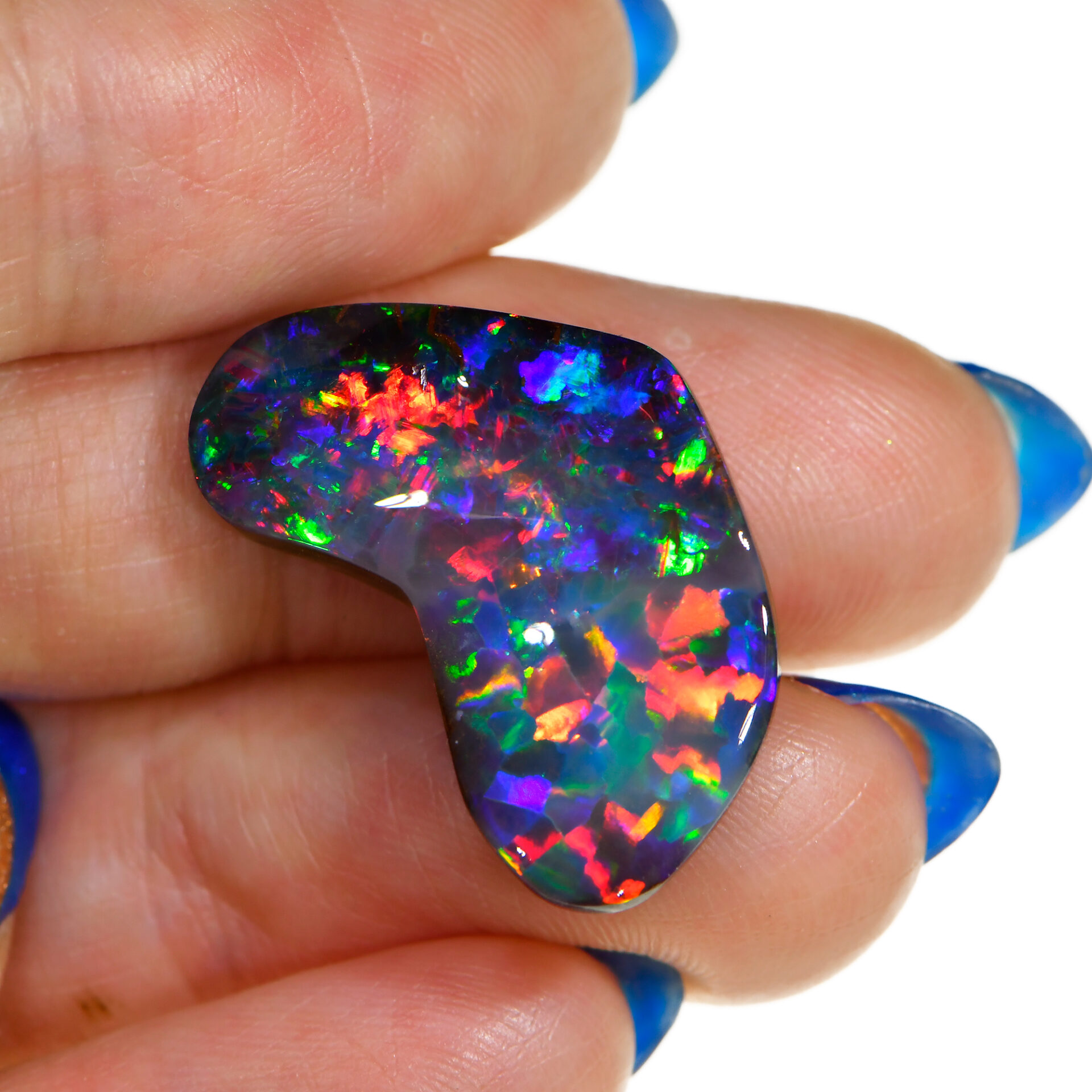
Pattern refers to the arrangement and shape of the color patches in the fire. Rare patterns carry large price premiums. Harlequin is the rarest pattern, found in less than 1% of all precious opals. A genuine harlequin pattern can multiply an opal’s price by 3 to 10 times compared to a common pattern at the same brightness and body color. Flagstone, Chinese writing, and broad flash are also premium patterns. Pinfire is the most common pattern and carries the lowest price premium. For a complete pattern breakdown, see our opal buying guide.
As a general rule, larger and bolder patterns are worth more than small, scattered patterns. Distinct, named patterns (harlequin, flagstone, Chinese writing, straw, ribbon, floral, peacock, mackerel, chaff) always carry more value than unnamed or generic patterns.
Directional Fire
The angles from which an opal shows its fire matter for pricing. An opal that displays strong fire from every viewing angle, both face up and in rotation, is more desirable and more valuable than one that only shows color from a single specific angle. The GIA refers to areas showing no fire as “dead spots,” and notes that multiple dead spots significantly reduce an opal’s value.
Origin
Origin affects both perceived value and actual market price. Lightning Ridge black opal is the most prestigious and expensive origin in the world. Within Lightning Ridge, specific mining fields carry different reputations. For example, a nobby black opal from the Allans Rush mining field is generally viewed more favorably in the market than a seam black opal from the Grawin fields.
Lightning Ridge crystal opal prices are usually higher than crystal opal prices from Coober Pedy, though exceptions exist for exceptional Coober Pedy stones. Boulder opal pricing also varies by region: Winton, Quilpie, Yowah, and Koroit each produce visually distinct material with different market demand.
Carat Weight
Opals are priced per carat (1 carat = 0.2 grams). Larger opals are rarer, so price per carat generally increases with size in the same quality range. However, unlike diamonds, opal pricing does not follow a predictable curve. A small 0.5 carat brilliant black opal with harlequin pattern can be worth more per carat than a large 8 carat medium brightness black opal with pinfire pattern. Quality always outweighs size.
Typical demand by size: under 1 carat for earrings and accent stones, 1 to 3 carats for rings and pendants (highest demand), 3 to 10 carats for statement pieces, and over 10 carats for collectors and museums.
Shape
Shape affects how easily an opal can be set in jewelry, which directly impacts its saleability and price. Oval cabochons are the most commercially desirable shape and typically carry the highest price premium. Pear (teardrop) shapes are also popular, especially for pendants. Freeform shapes are common in boulder opal but harder to sell because they require custom settings. A well shaped oval or pear opal will almost always sell faster and for more money than a freeform opal of the same quality.
Jewelry Settings
If an opal is already set in jewelry, the setting can add or subtract value. A well made platinum, 18 karat gold, or 14 karat gold setting with quality craftsmanship adds value above the opal alone. The precious metal weight should be factored into the total price. A poorly made or damaged setting can actually reduce the perceived value of the opal inside it.
What Makes Opal Prices Go Down
Understanding what lowers an opal’s price is just as important as knowing what increases it. The following issues can significantly reduce a stone’s market value.
Dead Spots and Potch on the Face
Dead spots are areas on the opal’s face where no fire is visible, only the background body color or plain potch (common opal without color). The more dead spots an opal has, the lower the opal price becomes. A small area of potch near the edge may have minimal impact, but large dead areas across the center of the face will drop the price dramatically.
Sand Marks, Scuff Marks, and Surface Damage
Scratches, sand marks, pitting, and scuff marks on the surface of a polished opal reduce its visual appeal. Opal has a hardness of 5.5 to 6.5 on the Mohs scale, making it softer than most gemstones. Surface damage is common in opals that have been worn in jewelry for years without repolishing. A professional repolish can often restore brightness and remove minor surface damage, potentially increasing the opal’s resale value.
Undulations and Uneven Surfaces
A well cut opal should have a smooth, evenly domed face. Undulations (bumpy or wavy areas on the surface) are a sign of poor cutting and reduce value. If the dome is noticeably uneven to the naked eye, the opal will be harder to sell and should be priced lower.
Excessive Potch or Ironstone Left by the Cutter

Some cutters intentionally leave extra potch on the back of an opal to increase its carat weight, making it appear more valuable than it is. Similarly, boulder opal cutters may leave unnecessary ironstone on the back to inflate weight. Always assess whether an opal has been cut efficiently. A properly cut opal should have enough backing for structural support and dome height, but not so much that it adds weight without adding beauty.
Cutters may also leave potch or imperfections on the edges of the face that should have been trimmed. Edge areas with dead spots, sand, or potch can often be removed with a small recut, but if they have been left on, the opal’s weight is artificially inflated and the opal price per carat is misleading.
Undesirable Shape
An opal cut into a symmetrical oval or teardrop is more commercially desirable than the same material left in a large freeform shape. Freeform opals require custom jewelry settings and appeal to a narrower market. When pricing a freeform opal, expect a discount of 10 to 30% compared to the same material cut into a standard shape.
Crazing
Crazing is a network of fine cracks that appear on or within an opal, usually caused by loss of moisture. It can result from exposure to extreme heat, dryness, or direct sunlight over extended periods. Crazed opals have very low market value because the cracks are permanent and cannot be repaired. According to the Australian Museum, opal is a hardened gel of silica and water, typically containing 6 to 10% water, which makes it sensitive to dehydration.
Wholesale vs Retail Opal Prices
The opal market has two distinct price levels that every buyer and seller should understand.
Retail opal prices are what end consumers pay when purchasing from a jewelry store, online dealer, or opal gallery. This price includes the dealer’s overhead, expertise, and margin.
Wholesale opal prices are what dealers pay when buying from miners, cutters, or other dealers. Wholesale prices for Australian opals are typically 25 to 50% lower than retail prices. This means a black opal listed at $5,000 retail may have been purchased wholesale for $2,500 to $3,750.
When selling an opal privately, pricing at or near wholesale level will result in a faster sale. Pricing at full retail is unlikely to attract buyers unless the seller has an established reputation and customer base.
Insurance valuations are a common source of confusion. Insurance appraisals are typically set at replacement value, which is often higher than the actual market selling price. An opal appraised at $10,000 for insurance purposes might realistically sell for $5,000 to $7,000 on the open market.
How to Research Opal Prices
Accurate pricing requires market research. The opal market is not centralised like the diamond market, so there is no single price list to consult. Instead, opal prices are based on comparing similar stones across multiple sources.
To research the current market value of an opal, identify its type, origin, body color, brightness, fire colors, pattern, shape, carat weight, and any flaws. Then search for similar opals currently listed for sale across multiple reputable dealers. Look at both current listings and recently sold opals if available. Compare at least 5 to 10 similar stones to establish a realistic price range.
Remember that listed retail prices are not the same as what an opal will actually sell for in a private sale. If using retail listings as a reference, reduce by 25 to 50% to estimate the wholesale or private sale value.
Opals are not graded as precisely as diamonds, where every stone of the same grade is roughly equivalent. Every opal is different, so pricing always involves a degree of professional judgment. Experienced opal dealers who handle thousands of stones per year have developed an intuitive sense of market value that comes from years of buying, cutting, and selling.
Opal Price Summary: Quick Reference
The factors below are listed from highest to lowest impact on opal price:
- Brightness: The most important single factor. A brilliant opal can be worth 10 times more than a dull opal of the same type and size.
- Body Color: Darker body colors increase value. Black opal commands the highest prices.
- Color of Fire: Red is rarest and most valuable. Multicolor outperforms single color.
- Pattern: Harlequin is rarest (3 to 10 times price multiplier). Broad patterns outperform pinfire.
- Type: Black opal is most expensive, followed by boulder opal, crystal opal, dark opal, white opal, doublet, then triplet.
- Origin: Lightning Ridge commands the highest premiums worldwide.
- Carat Weight: Larger stones are rarer, but quality outweighs size.
- Shape: Oval cabochons are most desirable. Freeform shapes sell at a discount.
- Clarity and Surface: Dead spots, crazing, sand marks, and undulations all reduce value.
- Cutting Quality: Excess potch, inflated weight, and poor dome shape reduce value.
For a complete guide to choosing the right opal, see our Australian opal buying guide. For investment specific guidance, read our article on buying black opals for investment.