Opal Galaxy Blog | Australian Opal Guides, Buying Tips & Collector Stories
Red Opal: Why Red Is the Rarest and Most Valuable Opal Color
Red opal is the most valuable color in the opal spectrum because red is the rarest play of color produced in nature, requiring the largest and most uniformly arranged silica spheres inside the stone to diffract light at the red wavelength. Red on black opal from Lightning Ridge sits at the absolute top of the market and can reach over $15,000 per carat for top grade stones, while red fire in crystal, boulder, and white opal also commands a premium over green, blue, and violet dominant stones. The rarity comes down to physics: red light has the longest wavelength in the visible spectrum, so opals capable of producing red are far less common than those showing greens and blues. Below is a full guide to red opal, covering why it is the most valuable, where it is mined, and what to look for when buying one.
Red is the rarest color found in precious opal, and it is the most valuable. Of all the spectral colors an opal can display, red occurs less frequently than any other because it requires the largest silica spheres to form, a condition that nature produces far less often than the smaller spheres responsible for blue or green. An opal displaying dominant red fire can be worth 5 to 10 times more per carat than a comparable stone showing only blue or green. Some buyers also choose opal colour for personal meaning, so you can read our guide, Choose Your Opal Colour Based on Your Star Sign. This guide explains exactly why red opal is so rare, how the color forms, where it is found, and what to look for when evaluating one.
How Red Forms in Opal: The Science
Opal is not a crystal. It is a hardened gel made of silica and water, typically containing 6 to 10% water according to the Australian Museum. Inside every precious opal, there are millions of tiny silica spheres packed together in a three dimensional grid. These spheres are so small they can only be seen under an electron microscope.
When white light enters an opal, it hits these silica spheres and bends. This bending is called diffraction, and it splits the white light into its individual spectral colors, the same way a glass prism splits sunlight into a rainbow. The size of the silica spheres determines which colors the opal produces.
Here is the key fact: smaller spheres produce shorter wavelengths of light, and larger spheres produce longer wavelengths. The visible light spectrum ranges from approximately 380 nanometres (violet) to 700 nanometres (red). That means:
Spheres around 150 to 200 nanometres in diameter produce violet and blue. These are the smallest spheres and the easiest for nature to form. This is why blue is the most common opal color.
Spheres around 200 to 250 nanometres produce green. Green is common in opals from nearly every origin.
Spheres around 250 to 300 nanometres produce yellow and orange. These are less common.
Spheres around 300 to 350 nanometres produce red. These are the largest spheres required for visible color in opal, and they are the hardest for nature to form. This is why red is the rarest opal color.
When the sphere diameter exceeds approximately 333 nanometres, diffraction moves into the infrared range and produces no visible color at all. The opal becomes potch (common opal without any fire). Red sits right at the upper boundary of what is physically possible for visible color in opal, which is a major reason it occurs so rarely.
The Rainbow Principle: Why Red Is Always Last
The formation of color in opal follows the same principle as how a rainbow forms. In a rainbow, sunlight passes through water droplets in the atmosphere, and the light bends and separates into its spectral colors. The colors always appear in the same order: violet and blue on the inside of the arc, then green, yellow, orange, and finally red on the outside.

Red is the last color to appear in a rainbow because it has the longest wavelength and requires the greatest degree of refraction. The same physics applies inside an opal. The smaller silica spheres that produce blue and green form more easily and more frequently during the millions of years it takes opal to develop underground. The larger spheres needed to produce red require very specific conditions: the right silica concentration, the right temperature, the right pH level, and enough time for the spheres to grow to the necessary size before the silica gel hardens.
According to Geoscience Australia, opals form when silica rich groundwater seeps into cracks and voids in rock and slowly hardens over millions of years. The silica spheres settle under gravity, and the rate of deposition is estimated at approximately one centimetre of thickness every five million years at a depth of forty metres. Growing spheres large enough to produce red requires this process to continue under ideal conditions for an extended period, which rarely happens.
This is also why an opal that shows red fire will almost always show every other color as well. Because the large spheres that produce red also diffract all shorter wavelengths, a red opal typically displays the full spectrum: red, orange, yellow, green, and blue. This makes red opals the most colorful of all opals, which further increases their value.
Where Red Opals Are Found
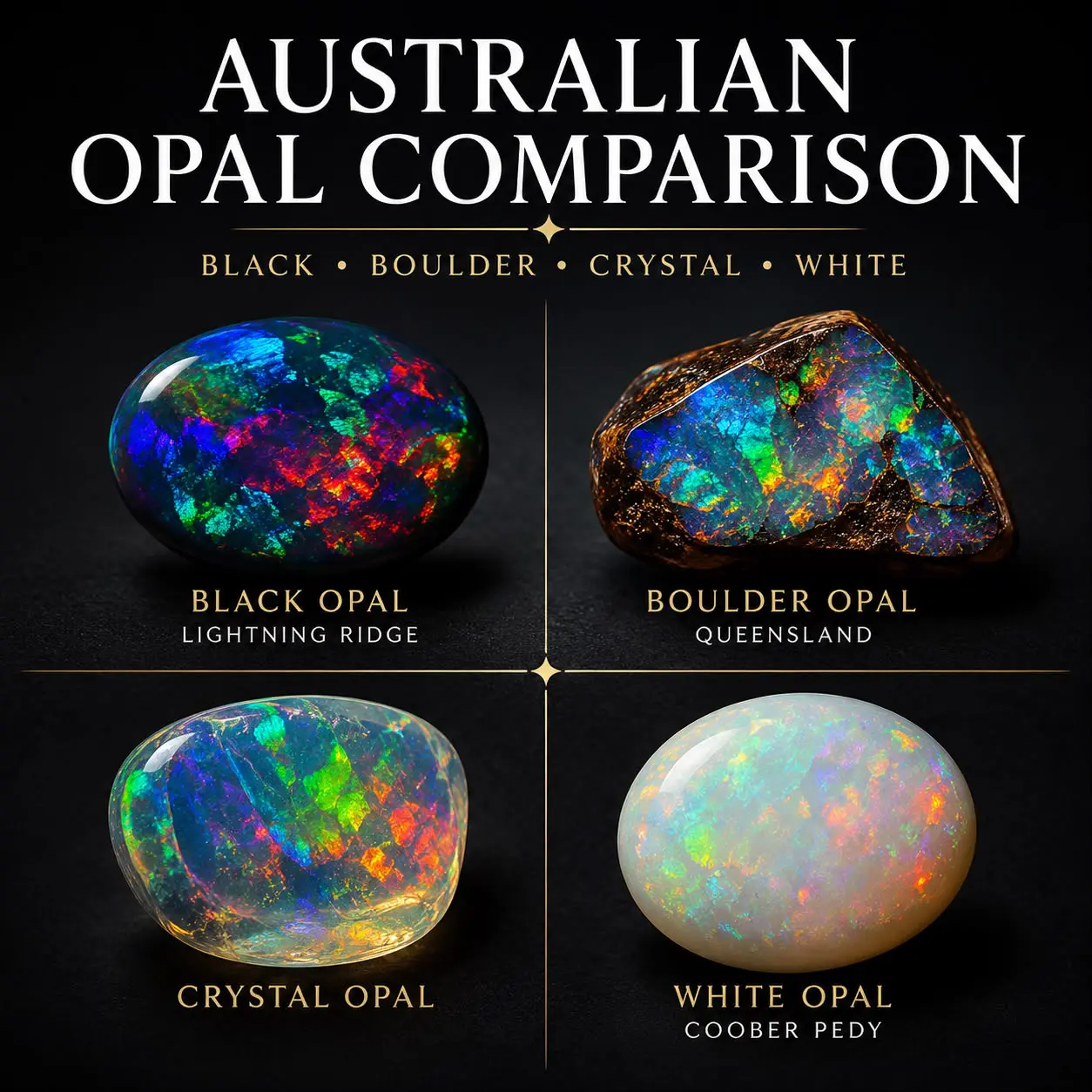
Red fire can appear in any type of Australian opal, but it is most commonly found, and most highly valued, in black opal from Lightning Ridge, New South Wales. The dark body color of black opal creates maximum contrast with the red fire, making the color appear far more vivid and intense than it would against a lighter background.

Lightning Ridge, New South Wales
Lightning Ridge is the primary source of the world’s finest red opals. The combination of black body color and dominant red fire in a Lightning Ridge opal represents the absolute peak of opal value. Red black opals from this region regularly sell for $5,000 to $50,000+ per carat depending on brightness, pattern, and coverage. The most famous and valuable opals ever discovered, including stones that have sold for six figure sums, have been red or multicolor black opals from Lightning Ridge. For more about this region, see our guide to the opal fields of Australia.
Queensland Boulder Opal Fields
Red fire also occurs in boulder opal from Queensland, though less frequently than in Lightning Ridge material. When red does appear in boulder opal, particularly from Winton or Koroit, it can be striking because the natural ironstone backing creates a dark background similar to black opal. Red boulder opals with full face coverage are rare and highly collected.
Coober Pedy, South Australia
White opal from Coober Pedy occasionally displays red fire, but the pale body color softens the visual impact. A red white opal from Coober Pedy is still more valuable than a blue or green white opal, but it will not match the dramatic contrast of a red black opal from Lightning Ridge.
Mintabie, South Australia
Dark opals from Mintabie have historically shown red fire, sometimes with broad flash patterns. Mintabie mining has largely ceased due to government policy changes, making authentic red Mintabie opals increasingly rare on the secondary market.
Crystal Opal
Red fire in crystal opal creates a unique effect because the transparent body allows light to pass through and interact with the color from multiple angles. A black crystal opal (transparent with a dark body) showing red fire is one of the most visually striking combinations in the opal world. These stones are rare and command strong premiums among collectors.
Red Opal vs. Fire Opal: An Important Distinction
There is a common confusion between “red opal” and “fire opal” that must be understood. These are two completely different things.
A red opal is any precious opal that displays red fire (play of color). The red comes from the diffraction of light through large silica spheres inside the stone. The body of the opal can be black, dark, white, or transparent. Red opal is an Australian specialty and is the most valuable color in precious opal.
A fire opal is a specific type of opal with a transparent orange, yellow, or red body color. Fire opals are mostly found in Mexico, not Australia. Most fire opals do not show any play of color at all. They are valued for their body color, not for spectral fire. Fire opals are significantly less expensive than Australian red precious opals.
When someone refers to “red opal” in the context of valuable Australian opals, they mean an opal with red play of color, not a Mexican fire opal.
How Red Affects Opal Value
Red is at the top of the opal color value hierarchy. The hierarchy from most to least valuable is: red, then orange, then yellow and gold, then green, then blue. This hierarchy exists because of the direct relationship between silica sphere size, rarity, and the physics of light diffraction.
Dominant Red vs. Partial Red

Not all red in opal is valued equally. The key distinction is between dominant red and partial red.
Dominant red means red is the primary fire color visible across the majority of the opal’s face. The stone reads as a “red opal” at first glance. Dominant red opals are the most valuable and command the highest per carat prices.
Partial red means the opal shows flashes of red alongside other colors, but red is not the dominant color. This is sometimes called “red on the roll” or “red on rotation” because the red only appears when the stone is tilted to certain angles. Partial red still adds significant value over an opal with no red at all, but it does not command the same premium as dominant red.
Red Combined with Rare Patterns
When red fire appears in a rare pattern, the value multiplies further. A harlequin pattern with dominant red fire on a black opal body is considered the single most valuable combination possible in the opal world. Such stones are so rare that most miners never find one in a lifetime of digging. The same applies to Chinese writing pattern with red fire, or flagstone patterns with red, both of which are exceptionally uncommon and highly sought after by collectors.
Price Impact of Red
To put the value difference in perspective: a bright black opal from Lightning Ridge showing only blue and green fire might sell for $1,000 to $3,000 per carat. The same stone, with identical brightness, body color, and pattern, but showing dominant red fire instead, could sell for $5,000 to $15,000+ per carat. Red can increase an opal’s value by 3 to 10 times compared to the same stone without red, all other factors being equal. For a deeper look at opal pricing, see our opal pricing guide.
How to Evaluate a Red Opal
When assessing a red opal, the following factors determine its value, listed from most to least important:
Brightness of the Red
A brilliant red that is visible in any lighting condition, including indoor light, is far more valuable than a dull red that only appears under direct light. Brightness is the most important single factor in all opal valuation, and it applies equally to red opals. A brilliant red opal will always outperform a dull one regardless of size or origin.
Dominance and Coverage
How much of the opal’s face shows red fire? An opal where red covers 80% or more of the face is worth dramatically more than one where red only appears in a small corner or on one specific angle of rotation. Full face red coverage is extremely rare.
Body Color
A dark body color (black opal) creates the strongest contrast with red fire, making the red appear more intense and vivid. Red fire on a white opal is still valuable, but the lighter background reduces the visual impact. This is why red black opals from Lightning Ridge are the most expensive opals in the world.
Pattern
Rare patterns (harlequin, flagstone, Chinese writing) combined with red fire create the highest possible values. Common patterns (pinfire, rolling flash) with red fire are still valuable but carry less of a premium.
Origin
Lightning Ridge red opals command the highest prices due to the region’s reputation and the scarcity of supply. Red opals from other Australian origins (Mintabie, Coober Pedy, Queensland) are valued lower per carat for equivalent quality, though exceptional specimens from any origin can still command strong prices.
Carat Weight
Larger red opals are exponentially rarer than smaller ones. A 3 carat black opal with dominant red fire is far rarer than a 0.5 carat stone with the same characteristics, and the price per carat increases accordingly.
Why Red Opals Are Becoming Rarer

New discoveries of high quality red opal are declining. Lightning Ridge, the world’s primary source, has been mined continuously since the early 1900s, and the easily accessible deposits have been largely worked out. Mintabie is effectively closed. Coober Pedy produces mostly white opal with limited red. Queensland boulder opal fields produce red fire only occasionally.
At the same time, global demand for Australian opals has increased significantly, driven by growing collector markets in Asia, North America, and Europe. The combination of declining supply and increasing demand has pushed prices for quality red opals steadily upward over the past two decades. Collectors and investors increasingly view red black opals from Lightning Ridge as a finite resource with strong long term value. For more on the investment perspective, see our guide to buying black opals for investment.
Summary
Red opal is the rarest and most valuable opal color because it requires the largest silica spheres to form, and nature produces these large spheres far less frequently than the smaller spheres that create blue or green. The same physics that places red on the outside of a rainbow, the last color to form through prismatic refraction, applies inside an opal. Red opals almost always display a full spectrum of other colors alongside the red, making them the most colorful opals in existence. The highest value red opals are Lightning Ridge black opals with brilliant, dominant red fire in a rare pattern like harlequin or Chinese writing. These stones represent the peak of the opal market and are considered among the rarest and most valuable gemstones on Earth.
For help evaluating any opal, see our Australian opal buying guide.