

Australian Opal
Home > Australian Opal
Australian opal is a natural solid gemstone from Australia known for its play of color. It forms over millions of years and is used in fine jewelry such as rings, pendants, and necklaces. Australia produces over 95% of the world’s precious opal.
Buy natural Australian opal gemstones directly from Opal Galaxy.
Explore black opal, boulder opal, crystal opal and white opal available for rings, pendants and fine jewelry.
Table of Contents
- What Is Australian Opal?
- Types of Australian Opal
- Where Is Australian Opal Mined?
- How Australian Opal Forms
- Why Australian Opal Is the Best Quality in the World
- Australian Opal Compared to Opal from Other Countries
- How to Value Australian Opal
- How to Care for Australian Opal
- Famous Australian Opals
- Opal as the October Birthstone
- Opal Engagement Rings
- Buy Australian Opal at Opal Galaxy
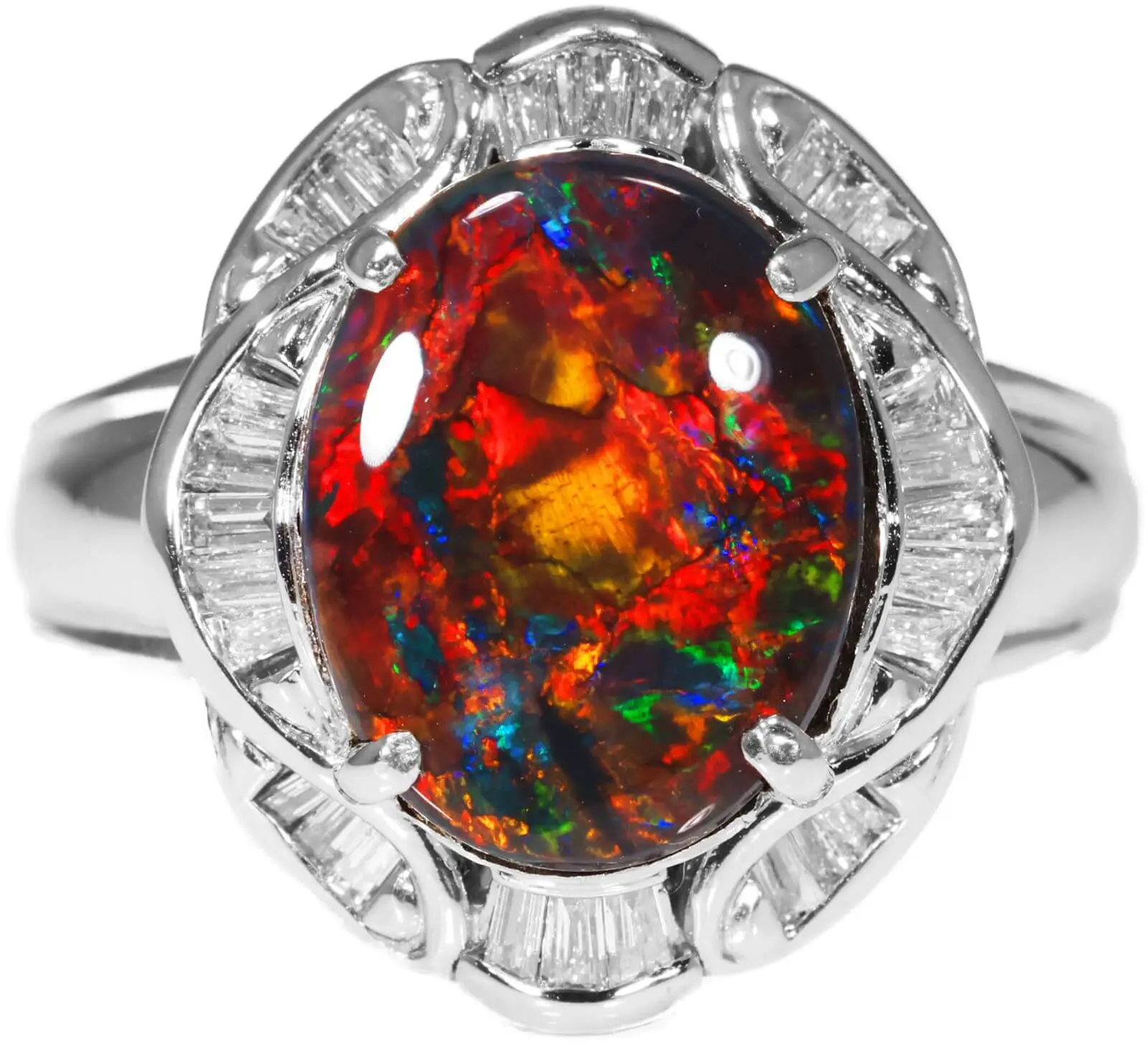
What sets Australian opal apart from all other gemstones is a natural optical effect called play of colour. As light enters the stone, it passes through microscopic silica spheres arranged in ordered layers and is diffracted into shifting flashes of red, blue, green, orange and every colour of the visible spectrum. No other gemstone on earth produces this effect.
Opal was declared Australia’s official national gemstone in 1993. Mining is concentrated across three states: New South Wales, Queensland and South Australia. No other country produces the same diversity of opal types, the same intensity of colour, or the same structural stability that has made Australian opal the standard by which all other opals are measured.
At Opal Galaxy, we sell exclusively natural, solid Australian opals sourced directly from these mining fields. Every opal in our collection is 100% natural, untreated and ethically mined.
Shop our full collection of Australian opals
What Is Australian Opal?
Australian opal is a precious gemstone made of silica and water. Its internal structure consists of microscopic silica spheres stacked in an ordered pattern. When white light enters the stone, these spheres split it into all the colours of the spectrum, creating the famous play of colour that makes precious opal unlike any other gem.
Most gemstones get their colour from chemical impurities. Opal is different. Its colour comes entirely from its physical structure. The size of the silica spheres inside the stone determines which colours appear. Larger spheres produce rare red and orange flashes. Smaller spheres produce blues and greens. When a single stone contains spheres of different sizes arranged in orderly layers, the result is a multicolour display that can show every colour of the rainbow at once.
Australian opal contains a moderate amount of water within its structure, which is a key reason the stone is so stable. Volcanic opals from other countries hold significantly more water and are more prone to cracking or colour change as a result.
Key characteristics of Australian opal:
- Play of colour: Shifting flashes of blue, green, red, orange and violet that move and change as the stone is tilted under light
- Rarity: Precious opal with play of colour represents only a small fraction of all opal mined. The vast majority is common opal (potch) without any colour display
- Stability: Australian opal does not absorb water, does not change in appearance, and holds its colour permanently under normal conditions
- Uniqueness: No two opals ever display the same pattern, colour combination or arrangement. Every stone is genuinely one of a kind
- Hardness: Suitable for all jewellery types including rings, pendants and earrings when set in appropriate protective settings
- Birthstone: Opal is the primary birthstone for October, and Australian opal is the most popular choice for birthstone jewellery worldwide
Opal is also one of the few precious gemstones where individual stones can rival or exceed the per carat value of diamonds. Top grade gem black opals from Lightning Ridge have sold for over $20,000 per carat.
Source: Geoscience Australia — Opal
Types of Australian Opal
Australia produces four main types of precious solid opal. Each type has distinct visual characteristics, geological origins and value positioning. Understanding the differences is essential when buying.
Precious Opal vs Common Opal (Potch)
Not all opal displays play of colour. Common opal, known in the industry as potch, lacks the orderly arrangement of silica spheres needed to diffract light. Potch appears as a solid colour, typically black, grey or milky white, without any colour flashes. While potch has limited value as a gemstone on its own, it plays an important structural role in black opal. A layer of dark potch beneath the colour bar intensifies the play of colour above it, acting as a natural dark canvas.
Black Opal
Black opal is the rarest and most valuable type of opal in the world. It is defined by its dark background, ranging from dark grey to jet black, which creates strong contrast that makes the play of colour appear more intense and vivid than in any other opal type.
The dark background comes from a natural layer of dark potch (common opal without colour) sitting beneath the colour bar. This dark base amplifies every flash of colour above it, producing displays of red, blue, green and multicolour fire that no other gemstone can match.
Almost all commercial black opal comes from Lightning Ridge in New South Wales, Australia. Top grade gem black opal with strong red fire can reach values exceeding $20,000 per carat, placing it among the five most valuable gemstones in the world.
The darker the background of a black opal, the more intense the colours appear. Stones with a slightly lighter dark background are often called dark opals. They still display strong colour but tend to be more accessible in price than the deepest black specimens.
Explore our Lightning Ridge black opal gemstones for sale
Boulder Opal
Boulder opal is found exclusively in Queensland, Australia. Precious opal forms naturally within cracks and cavities in ancient ironstone boulders. Unlike other opal types that are cut free from their surrounding rock, boulder opal retains its natural ironstone backing because the opal seams are often too thin to survive separation.
The result is a gemstone with a distinctive earthy character. Vivid veins and patches of colour sit against dark brown ironstone, creating organic, individual pieces that often look like small landscape paintings from the Australian outback.
Boulder opal is valued for its natural durability (the ironstone backing adds structural strength), its strong colour contrast and its suitability for bold jewellery designs. Mining regions include Winton, Koroit, Yowah, Quilpie and other fields stretching across western Queensland.
A special sub type, crystal boulder opal, forms in sandstone rather than ironstone. These stones have a lighter, more translucent quality with a crystallised appearance that allows light to pass through the stone.
Shop Australian boulder opal for jewelry
Crystal Opal
Crystal opal is defined by its transparency. Light passes through the stone, creating a three dimensional effect where colours appear to float and glow from within. This internal depth gives crystal opal a visual quality that opaque opal types cannot produce.
Crystal opal covers the full range of background shades, from completely colourless through to rare black crystal opal that combines transparency with a dark background. The clearest specimens can be polished on both sides, revealing colour from every angle.
Crystal opals are sourced from Lightning Ridge (black crystal varieties), Coober Pedy, Mintabie and Andamooka in South Australia, and select Queensland fields. They are particularly popular for fine jewellery where open back or elevated settings allow light to enter from behind and illuminate the full colour display.
Browse natural crystal opal gemstones
White Opal
White opal, also called light opal, features a pale milky background with softer, pastel play of colour. It is the most widely available type of Australian opal and is primarily mined at Coober Pedy in South Australia, the town known as the opal capital of the world.
While white opal is generally the most affordable type of Australian opal, high quality specimens with bright, vivid colour still command strong prices. The lighter background creates a gentle, elegant display that works well for everyday jewellery and classic designs.
View white opal for rings and pendants
Doublets and Triplets
In addition to solid opals, the market includes composite stones called doublets and triplets.
A doublet is a thin slice of natural opal bonded to a dark backing, typically black potch, ironstone or resin. A triplet adds a clear quartz or glass dome on top to magnify the colour. Doublets and triplets are not classified as solid opals and are sold at a fraction of the price. They offer an affordable way to experience opal colour, but require extra care. Prolonged water exposure can weaken the adhesive bond between layers.
At Opal Galaxy, we clearly distinguish between solid opals and composite stones. Our core collection is natural, solid Australian opal.
Where Is Australian Opal Mined?
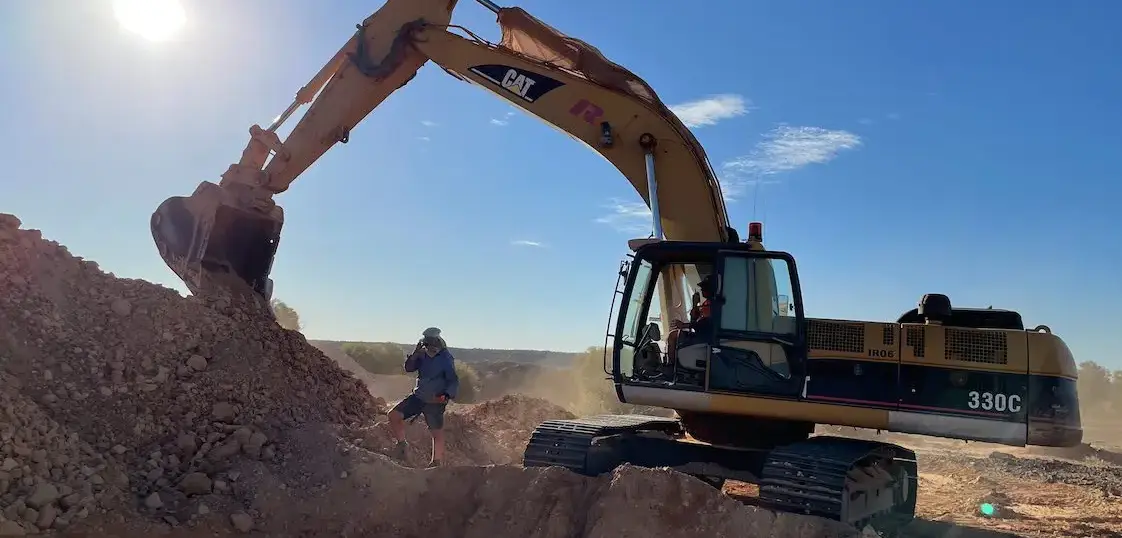
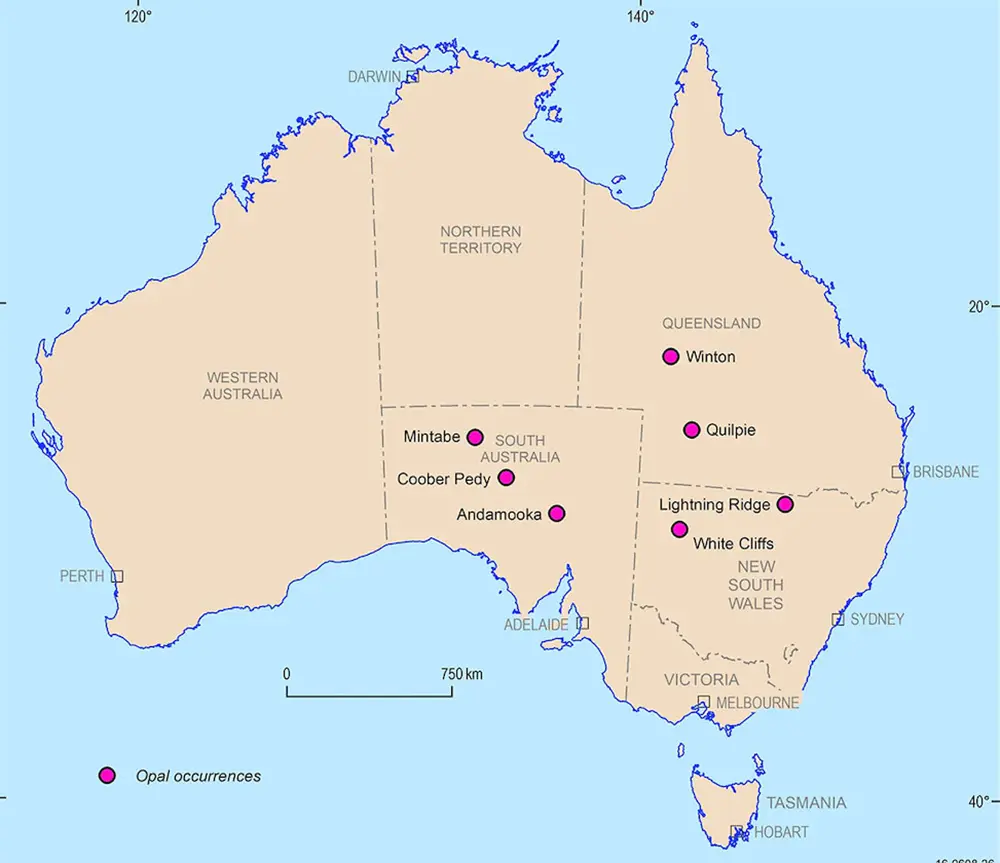
Australian opal mining is concentrated in three states. Each state produces distinct opal types shaped by millions of years of unique geological conditions. For a full breakdown, see our detailed guide to the opal fields of Australia.
New South Wales
Lightning Ridge is the most famous opal mining region on earth and the world’s only significant commercial source of black opal. Located in northern New South Wales, Lightning Ridge produces black opal, dark opal, black crystal opal and light crystal opal from sedimentary deposits within sandstone and claystone formations. Mining is predominantly small scale, with family run operations sinking vertical shafts and tunnelling horizontally to follow opal bearing layers.
White Cliffs is Australia’s oldest commercial opal field, with mining dating back to the late 1800s. White Cliffs is known for its “pineapple opals,” which are opal pseudomorphs that have replaced glauberite crystals in distinctive shapes, as well as classic white and crystal opals.
Queensland
Queensland is the exclusive home of boulder opal. Opal fields stretch across a vast zone of western Queensland, from Cunnamulla and Eulo in the south to Kynuna in the north, a distance of over 700 kilometres. Key mining towns include Winton (the largest boulder opal discovery to date), Koroit (famous for distinctive ironstone matrix patterns), Yowah (known for Yowah nuts, small ironstone nodules containing opal centres) and Quilpie.
Queensland boulder opal forms when silica rich water seeps into cracks within ancient ironstone formations over millions of years, creating precious opal seams within the host rock.
South Australia
Coober Pedy is the world’s largest source of white opal and has been producing continuously since 1915. The remote desert town is famous for its underground residences, called dugouts, where residents live below ground to escape extreme temperatures. Coober Pedy also produces crystal opal and traces of black opal.
Andamooka produces white, crystal and occasionally matrix opal. Mintabie is geologically different from all other major Australian opal fields, forming in much older rock. This has produced distinctive crystal and black crystal opals, although production has dropped significantly in recent years.
How Australian Opal Forms
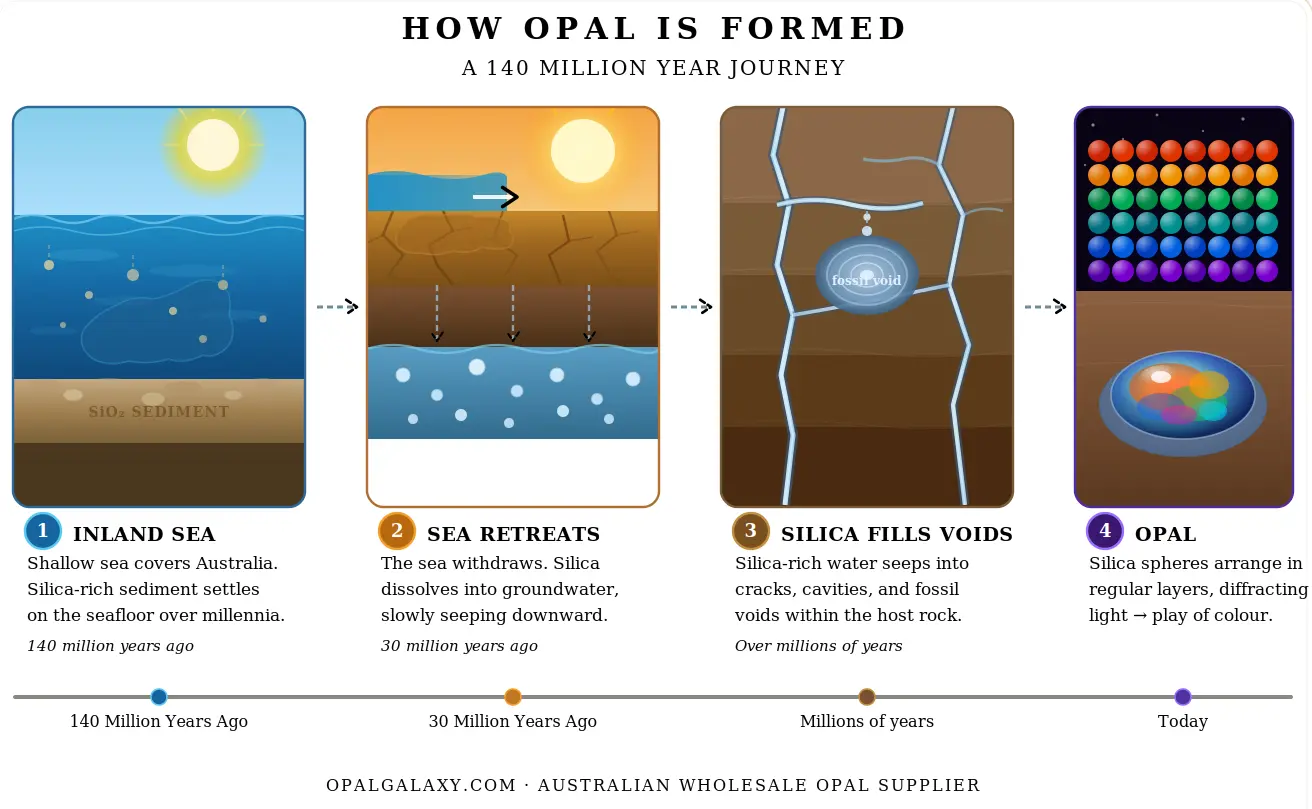
Australian opal formed over 100 million years through a process unique to Australia. A vast inland sea called the Eromanga Sea once covered more than 60% of the continent, depositing thick layers of silica rich sediment. As the sea retreated, weathering dissolved silica from these rocks into groundwater, which slowly filtered into cracks, cavities and fossil voids deep underground. Over millions of years, the silica settled as tiny spheres that hardened into opal — and when those spheres arranged in orderly layers, the result was precious opal with play of colour.
This process happened in stable rock over an immense span of time, which is why Australian opal is fundamentally different from volcanic opals found in Ethiopia, Mexico and elsewhere. Research from the University of Sydney confirmed that the geological events behind Australian opal have no known parallel anywhere else on earth.
Sources: University of Sydney geological research; Geoscience Australia
Why Australian Opal Is the Best Quality in the World
Australian opal has been the global standard for quality for over 130 years. Several measurable factors contribute to this:
Structural stability. Australian opal forms slowly in sedimentary rock over millions of years. The result is a stable gemstone that does not absorb water, does not change appearance with humidity and does not crack or craze under normal conditions. Volcanic opals from Ethiopia are hydrophane, meaning they absorb water and can temporarily or permanently change in appearance.
Superior colour intensity. The geological conditions in Australia produced silica spheres of consistent uniformity. This translates directly to brighter, more vivid and more reliable play of colour than opal from any other origin.
Diversity found nowhere else. No other country produces all four major opal types (black, boulder, crystal and white) in commercial quantities. Australia offers the full spectrum of opal varieties, patterns and colour combinations, from the deepest black opal to the most transparent crystal.
The full colour spectrum. Australian opal can display every colour visible to the human eye: blue, green, yellow, orange, red, violet and pink, often with multiple colours appearing simultaneously in a single stone. Red is the rarest and most valuable colour because the internal conditions needed to produce red occur far less frequently than those that produce blue or green.
Ethical and regulated mining. Australian opal mining operates under strict government regulation, with environmental rehabilitation requirements, fair labour practices and licensing systems. Most operations are small scale and family run, not industrial mines. This makes Australian opal one of the most ethically sourced gemstones available.
Proven long term value. As Australian mining fields gradually deplete and operating costs continue to rise, the supply of high quality Australian opal tightens while global demand grows. Top grade specimens, particularly gem black opal, have demonstrated strong appreciation in value over decades. Learn more in our guide to opal as an investment.
Australian Opal Compared to Opal from Other Countries
Australia dominates world opal production, but opal is also mined in several other countries. Each origin produces opal with different characteristics, stability and market value. Here is how they compare.
Australian Opal vs Ethiopian Opal
Ethiopian opal, primarily from the Welo province, is the most significant non Australian source to emerge in recent decades. Ethiopian opal can display vivid colour and is sold at lower price points than equivalent Australian stones. However, the two are fundamentally different gemstones in terms of geology and behaviour.
|
Factor |
Australian Opal |
Ethiopian Opal |
|---|---|---|
|
Formation |
Sedimentary rock, formed over millions of years |
Volcanic rock, younger deposits |
|
Water content |
Moderate and stable |
Higher and variable (hydrophane) |
|
Water absorption |
Does not absorb water |
Absorbs water, can change appearance |
|
Crazing risk |
Very low under normal conditions |
Higher, especially with temperature or humidity changes |
|
Colour permanence |
Permanent |
May temporarily lose colour when wet or in humid conditions |
| Treatment | Rarely treated; natural colour is standard | Often treated (smoke treatment to darken the background) |
| Market history | 130+ years of established global trade | Commercial production since early 2000s |
| Investment value | Strong long term appreciation, especially black opal | More affordable but less established for investment |
Both can be beautiful gemstones. But for buyers seeking permanence, stability and long term value, Australian opal is the clear choice. You can shower with a solid Australian opal ring on and it will not change. You cannot do that with most Ethiopian opal.
Australian Opal vs Mexican Opal
Mexico produces fire opal, a type of opal characterised by a warm orange, yellow or red body colour. Mexican fire opal can be transparent and is sometimes faceted like a traditional gemstone rather than cut as a cabochon.
The key difference is that most Mexican fire opal does not display play of colour. It is valued for its body colour alone, not for flashes. This makes it a fundamentally different product to Australian precious opal. Mexican fire opal is also volcanic in origin, with higher water content and a greater tendency to crack over time compared to Australian sedimentary opal.
Some Mexican opal does show play of colour and is marketed as “precious Mexican opal,” but the intensity, stability and colour range of these stones does not rival Australian material.
Australian Opal vs Brazilian Opal
Brazil produces small quantities of precious opal, primarily white and crystal varieties from the state of Piauí. Brazilian opal can show play of colour and is sometimes marketed as a budget alternative to Australian opal.
However, Brazilian production volumes are tiny compared to Australia, the opal tends to be less stable, and the diversity of types and colours is far more limited. Brazilian opal does not produce black opal or boulder opal in any meaningful commercial quantity.
Australian Opal vs Honduran Opal
Honduras has produced opal for centuries, including some black opal varieties. Honduran opal is volcanic in origin and can display play of colour, but it is known for being less stable than Australian opal, with a higher tendency to craze or lose colour over time. Production volumes are very small and the stones are not widely available in the international market.
Australian Opal vs American Opal (Nevada)
The Virgin Valley region of Nevada produces precious opal including black, crystal and fire varieties. Some Nevada opals are among the most visually striking in the world. However, many Virgin Valley opals have high water content and are notorious for cracking and crazing after mining, sometimes within days or weeks of being removed from the ground. This instability makes them unsuitable for most jewellery applications.
A small percentage of Nevada opal is stable enough for jewellery use, but it is extremely rare and does not approach the scale or consistency of Australian production.
Why Australia Remains the Global Standard
The comparison across all origins comes down to three things: stability, diversity and track record.
Only Australian opal offers all four major types in commercial quantity. Only Australian sedimentary opal provides the structural stability needed for lifelong wear in jewellery. And only Australian opal has a 130 year market history that gives buyers, collectors and investors confidence in long term value. There is a reason that over 95% of the world’s precious opal comes from Australia. No other geological environment has produced anything equivalent.
How to Value Australian Opal
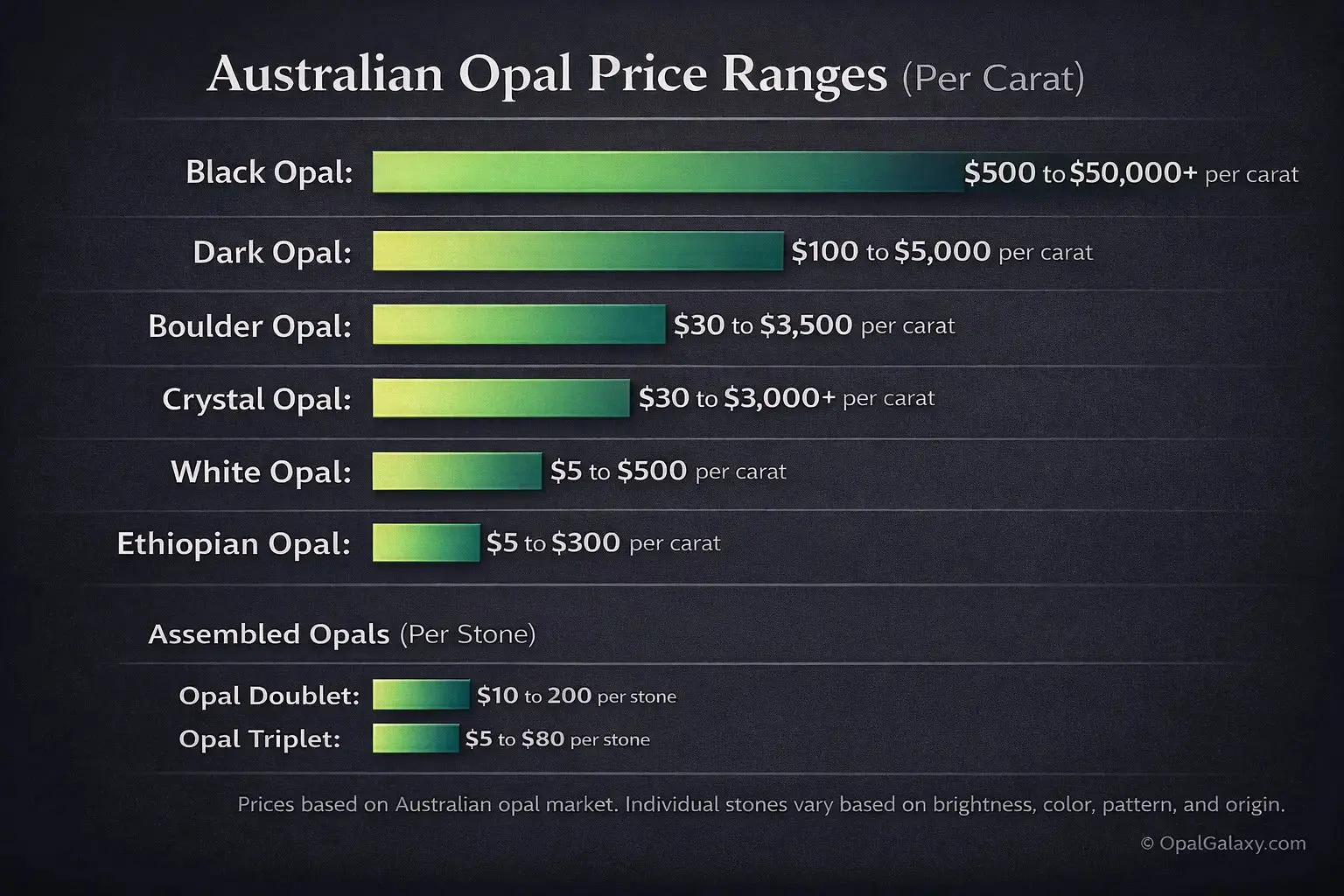
Opal valuation is more complex than most gemstones because every stone is unique. The key factors that determine value are:
- Opal type. Black opal commands the highest prices, followed by boulder opal and crystal opal, with white opal generally being the most affordable.
- Background colour. Darker backgrounds generally increase value because they create stronger contrast against the play of colour. This is why black opal commands the highest prices.
- Brightness. The intensity of the play of colour under normal lighting conditions. Brighter opals with vivid, easily visible colour are worth more than stones where colour is faint or hard to see.
- Colour range. Opals displaying red are the rarest and most valuable. Multicolour stones showing red alongside blue, green and other colours command premium prices. Blue and green alone, while attractive, are the most common colours and carry lower per carat values.
- Pattern. Named patterns include harlequin (a checkerboard arrangement of colour blocks and the most valuable pattern), broad flash, rolling flash, pinfire, ribbon and floral. Rare patterns increase value significantly.
- Size and carat weight. Larger stones with strong colour are exponentially rarer than smaller ones. A 5 carat black opal with red fire is not five times the value of a 1 carat stone with the same qualities; it can be ten or twenty times the value.
- Origin. Lightning Ridge black opal carries the highest origin premium. Boulder opal from specific Queensland fields like Koroit and Yowah also has origin recognition among experienced buyers.
- Cut and finish. A well proportioned, expertly polished opal that maximises colour display and pattern visibility adds to value. Poor cutting can waste colour or create an awkwardly shaped stone that is harder to set.
At Opal Galaxy, we believe every opal should be judged by how it looks, not by a number on a chart. That is why we photograph and film every stone so you can see exactly what you are getting. Read more about our blog How to value Australian Opal
How to Care for Australian Opal
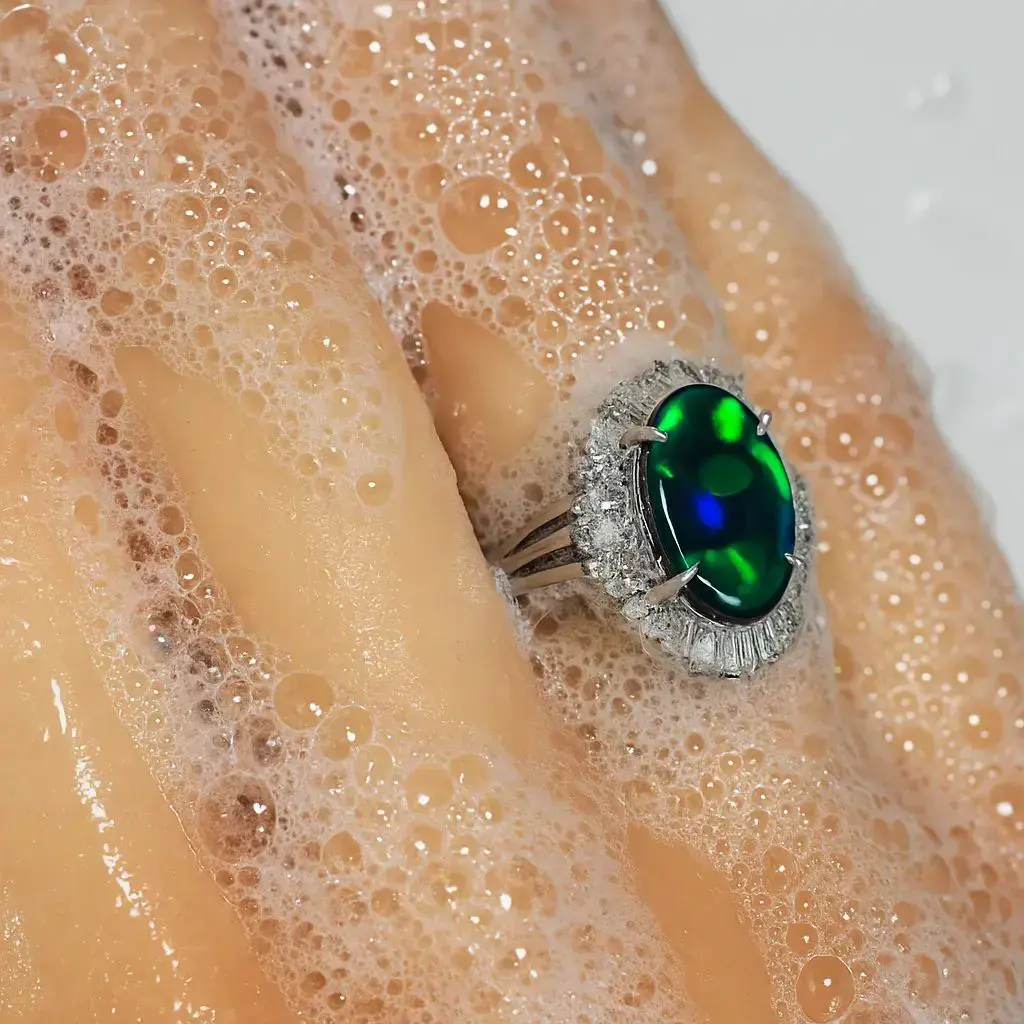
Natural solid Australian opals are durable gemstones when treated with basic care:
- Clean gently with mild soap and lukewarm water using a soft cloth. Dry thoroughly.
- Avoid ultrasonic cleaners, steam cleaners, harsh chemicals, bleach and abrasive materials.
- Remove opal jewellery before swimming in chlorinated pools, using household chemicals or doing heavy physical work.
- Store opals separately in soft pouches or lined boxes to prevent scratching from harder gemstones like diamonds and sapphires.
- Avoid sudden extreme temperature changes, though normal daily temperature variation will not affect solid Australian opal.
Common myth debunked: Australian opals do not need to be stored in water. They will not dry out, crack or lose colour if kept in normal conditions. This myth likely comes from confusion with hydrophane opals from Ethiopia and other volcanic sources, which do react to moisture changes. Solid Australian opal is not hydrophane. Read More About How to Care For Australian Opals
Famous Australian Opals
Several Australian opals have achieved legendary status and demonstrate the potential value of this gemstone:
The Aurora Australis. Discovered at Lightning Ridge in 1938, this 180 carat black opal is widely regarded as the most valuable single opal in existence. It displays a full spectrum of colours against a dark background with a distinctive starfish pattern. Its value has been estimated in the millions.
The Olympic Australis. Found at Coober Pedy in 1956 during the Melbourne Olympic Games, this is the largest and most valuable gem opal ever discovered. It weighs 17,000 carats (3.4 kilograms) and remains one of the most important gemstone finds in history.
The Fire of Australia. A 998 carat black opal from Lightning Ridge known for its intense multicolour fire across a large, clean face. It is considered one of the finest examples of what Lightning Ridge can produce.
These specimens show what makes opal different from other gemstones. A single discovery from a small, independent mine can be worth more than a diamond of equivalent size. This is why opal mining in Australia continues to attract new prospectors, and why the best Australian opals are treated as serious investments by collectors worldwide.
Opal as the October Birthstone
Opal is the primary birthstone for October, recognised by the Gemological Institute of America (GIA) and every major gemological authority. For October birthstone jewellery, Australian opal is the most popular and highest quality choice because every stone is unique, the colour range spans the full visible spectrum, and solid Australian opal is stable enough for everyday wear.
Whether set in a ring, pendant or earrings, Australian opal birthstone jewellery carries personal meaning that mass produced gemstones cannot offer. No two opals are alike, making each piece a true one of a kind gift.
Opal Engagement Rings
Australian opal is increasingly chosen for engagement rings by buyers who want something with more character and individuality than a traditional diamond. Black opal engagement rings from Lightning Ridge, in particular, have grown in popularity because of the intensity of their colour, their rarity, and the fact that no other ring in the world will ever look the same.
Opal is softer than diamonds or sapphires, but it is absolutely suitable for daily wear in engagement rings when set in protective designs such as bezel settings or halo settings with raised shoulders. Boulder opal is especially durable for rings due to its natural ironstone backing.
Browse our opal ring collection
Buy Australian Opal at Opal Galaxy
Opal Galaxy is a registered Australian wholesale opal seller established in 2012, with over 13 years of experience in the global opal trade. We are a proud member of the Opal Association and the International Gem Society.
Every opal in our collection is:
- 100% natural — never synthetic, treated or enhanced
- Solid Australian opal — clearly distinguished from doublets and triplets
- Ethically sourced — from regulated Australian mining operations
- Individually photographed and filmed — showing true colour and pattern as it appears in person
- Shipped worldwide with complimentary insured shipping on orders over $200
- Backed by a certificate of authenticity available on request
Shop by opal type:
- Black Opal — Lightning Ridge’s rarest gemstones
- Boulder Opal — Queensland’s natural ironstone treasures
- Crystal Opal — Transparent brilliance and depth
- White Opal — Classic elegance from South Australia
- Rough Opal — Uncut material for cutters and collectors
- Opal Jewellery — Rings, pendants and earrings in gold, platinum and silver
Shop by colour:
- Red Opal — The rarest colour in the opal spectrum
- Multicolour Opal — Full spectrum rainbow displays
- Blue Green / Ocean Opal — Oceanic hues and calming tones
Featured Opals
Add to Wishlist 

Black Opal 9.82ct Certified Neon Rainbow Fire Butterfly Wing
US$22,640 Add to Wishlist 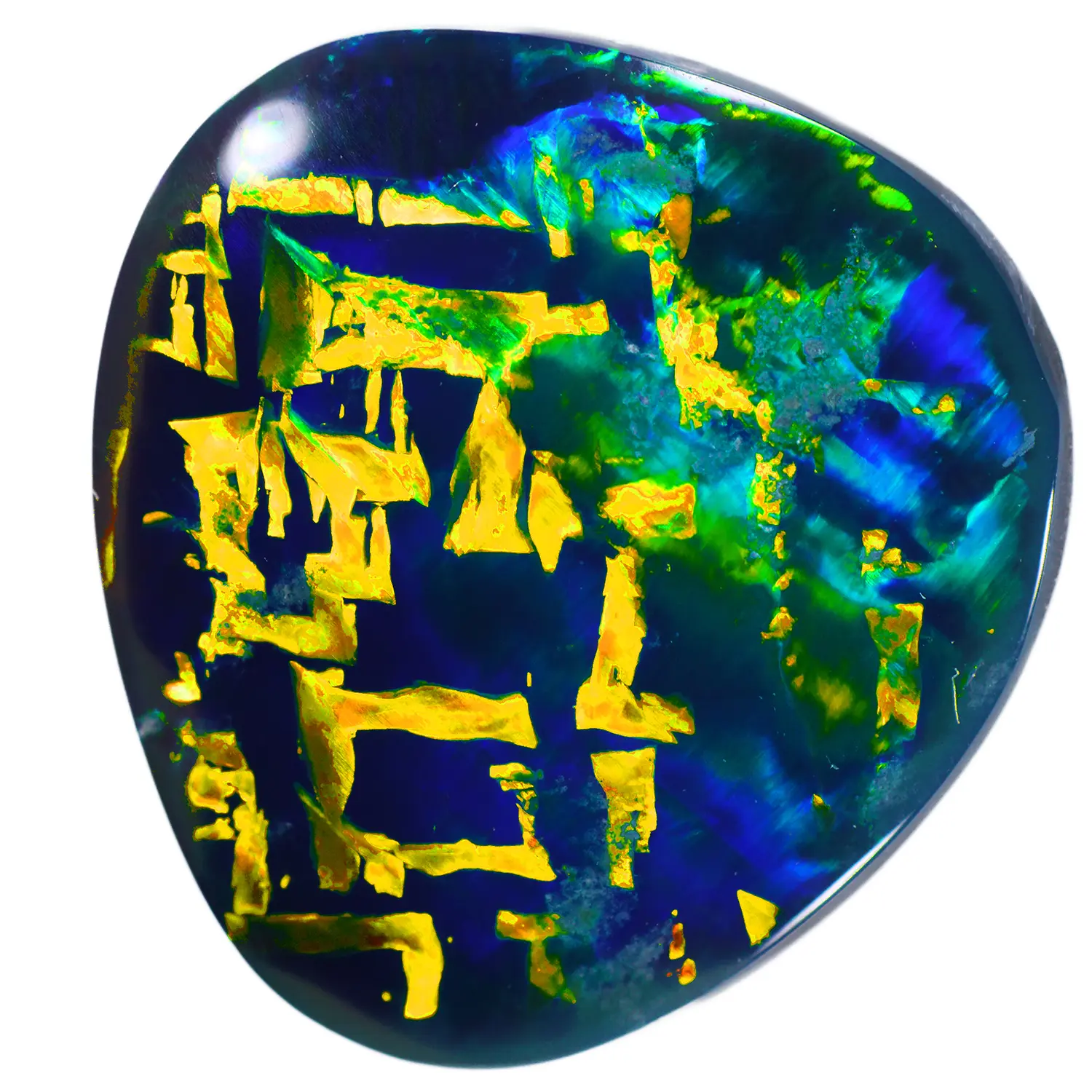
 Add to cart
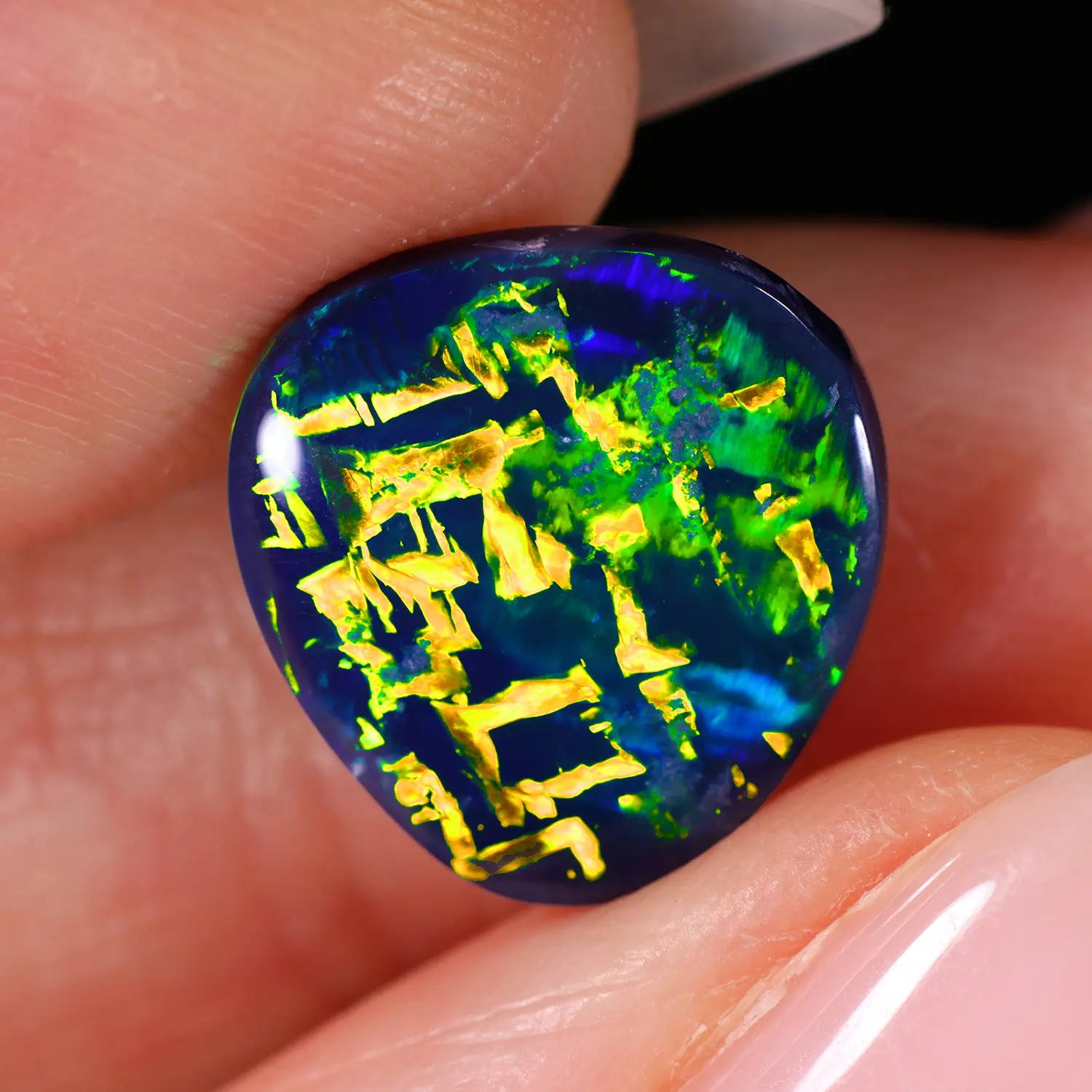
3.95ct Certified Black Opal Chinese Writing Pattern
US$18,800 Add to Wishlist 
 Add to cart
5.47ct Black Opal Blue Green Fire
US$10,985 Add to Wishlist 

4.95ct Natural Black Opal Oval Rainbow Floral Mosaic Pattern
US$6,700